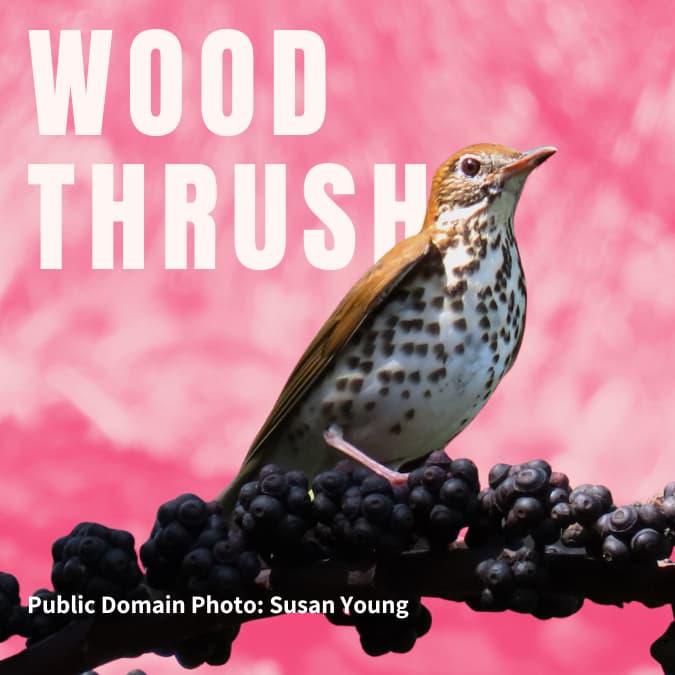
The Wood Thrush (Hylocichla mustelina) is the ghost of the eastern forest—heard before seen, once filling every eastern woodlot, now down nearly 60% since 1970. Behind its collapse lies an invisible chemical chain: acid rain dissolves forest calcium, snails disappear, and females can no longer produce viable eggs. Washington, D.C.’s official bird is running out of places to thrive.
The Voice That Calls Spring
One voice is fading from the dawn chorus.
Not the sound itself—not yet. Stand in a mature eastern deciduous forest on a May morning, and you will still hear it: a flute-like cascade, three phrases building through the canopy with a quality Thoreau described as declaring “the immortal wealth and vigor that is in the forest.” The Wood Thrush’s ee-oh-lay is among the most instantly recognizable sounds in North American birding. It is also the sound of a species losing its footing.
Burroughs called the Wood Thrush “a royal minstrel,” noting he “perhaps contributes more than any other bird to our sylvan melody,” given his “liberal distribution throughout our Atlantic seaboard.” Quote ID: 1-119 He wrote this in 1871 without caveat, from a Hudson Valley landscape where the bird was simply part of the architecture of summer, as reliable as the heat.
He could not have known what was accumulating in the clouds.
Since 1970, the Wood Thrush has lost 59% of its population8,. The Atlantic Coast and New England—the heart of Burroughs’s world, the core of the species’ range—have suffered the steepest declines.
Understanding why requires following a chain of causation so indirect, so counterintuitive, that it took decades to name. The story is about rain, calcium, snails, and a Cornell ornithologist who refused to accept the obvious explanation.
Conservation: Historical Baseline (Burroughs Era)
In 1871, the eastern deciduous forest was intact in ways that are difficult to imagine today. Acid deposition was a century away from reaching ecologically significant levels. The industrial coal-burning that would eventually acidify precipitation across the Appalachians and Northeast was just beginning. The forest floor—moist, deep in leaf litter, rich with invertebrates—functioned as it had for millennia.
The Wood Thrush was a creature of this system. “But the crowning glory of all these robins, flycatchers, and warblers is the wood thrush,” Burroughs wrote. “More abundant than all other birds, except the robin and catbird.” Quote ID: 1-108 He documented the bird’s tameness, its willingness to sing directly above human dwellings, and its presence in every suitable woodlot from Georgia to southern Canada.
This was Accidental Abundance—wildlife populations at a pre-industrial baseline because the conditions that would diminish them had not yet arrived.
The Wood Thrush required, and found in abundance, three things: mature deciduous forest with a developed understory and moist soil; deep leaf litter teeming with invertebrates; and calcium-rich food sources—particularly land snails, isopods, and earthworms—critical for egg production. Female Wood Thrushes require 10 to 15 times as much calcium to produce a clutch as a similarly-sized mammal needs to nurture its young1. This is not a minor dietary preference. It is a hard physiological requirement that the forest, in 1871, met easily.
The species was also a bird of the forest interior. It avoided edges, preferring stands where the canopy reached 50 feet or more, where moist soil stayed undisturbed, and where cowbirds and predators found less access than at the woodland margins. In the pre-industrial, pre-fragmented eastern forest, this habitat was everywhere.
Burroughs recorded a landscape where the Wood Thrush song was the dominant voice of the understory from May through July. He took it for granted, as one takes for granted the things that seem permanent.
Conservation: The Decline
The numbers are clear. The Wood Thrush has lost 59% of its population since 19708. The North American Breeding Bird Survey records a cumulative decline of 45% between 1966 and 2023, at roughly 1% per year1. In high-elevation zones—the Adirondacks, the Allegheny Plateau, portions of the Appalachians—annual declines run as steep as 5%6. Partners in Flight rates the species 14 out of 20 on its Continental Concern Score and has kept it on the Watch List for over a decade8. The 2025 State of the Birds report designates it a Yellow Alert Tipping Point species—a bird that has lost more than half its population and not recovered1. Smithsonian conservation scientist Peter Marra has warned that the Wood Thrush could become “the next passenger pigeon”9.
The standard explanations are real but incomplete. Habitat fragmentation reduces nest success and increases predator access. Loss of primary tropical forest in Central America removes the interior habitat the species requires in winter. These factors matter.
But the steepest declines occur in precisely the places where forest remains relatively intact: high-elevation northeastern forests, where acid deposition has been most severe.
Something else was happening. Something invisible.
The Calcium Cascade begins with acid rain. Sulfuric and nitric acid deposited by precipitation since the mid-20th century leach calcium from forest soils across the Northeast and Appalachians. The soil loses its buffering capacity. Calcium-dependent invertebrates—particularly land snails—collapse. On sensitive sites, acid precipitation can depress snail populations by up to 80%7. In healthy sugar maple stands, earthworm biomass is up to 34 times greater than in declining maple stands with calcium-poor, acidic soils4. The forest floor becomes a calcium desert.
A female Wood Thrush arrives in May, ready to breed. She needs calcium-rich food to build eggs. The snails are gone. The earthworms are depleted. She forages harder, travels farther. Research on tree swallows nesting near acidified lakes found birds traveling up to 650 meters (710 yards) from the nest to find calcium-rich supplemental food5. The energetic cost is steep. Some females do not attempt breeding at all. Others produce eggs with compromised shells. The season fails.
A second threat compounds this in fragmented Midwestern landscapes. The Brown-headed Cowbird—a nest parasite that thrives at agricultural and suburban edges—follows fragmentation inward. In heavily fragmented Illinois forest tracts, 75 to 95% of Wood Thrush nests were parasitized, with some sites averaging more than four cowbird eggs per nest13. Wood Thrushes accept cowbird eggs without ejecting them, raising the intruders as their own. In the worst-affected fragmented landscapes, thrushes were fledging more cowbirds than their own young.
The cowbird problem is local and variable—acute in the fragmented Midwest, lower elsewhere. The acid rain calcium collapse is continental, consistent, and worsening precisely where the forest appears intact. Both threats are real. Only one is invisible.
Conservation: The Detection
The connection between acid rain and Wood Thrush decline was not obvious. Population models pointed to habitat fragmentation. Research focused on tropical wintering grounds. The calcium hypothesis had been explored in European ornithology—Dutch researchers documented great tit eggshell thinning linked to snail loss in acidified forests—but no one had applied it rigorously to North American songbird declines at a continental scale.
What made the breakthrough possible was data that no single research team could have generated alone.
The Birds in Forested Landscapes project, a citizen science initiative administered by the Cornell Lab of Ornithology, had deployed thousands of volunteers across the Wood Thrush’s breeding range. These participants recorded the presence or absence of breeding Wood Thrushes at more than 650 study sites, with detailed information on topography, elevation, vegetation, and habitat fragmentation6. The Citizen Science Revolution had produced a geographic resolution that smaller studies could not match.
Ralph S. Hames, a postdoctoral associate at the Cornell Lab, used this dataset to build something new: a statistical model sophisticated enough to separate the effects of acid deposition from the effects of fragmentation, soil type, elevation, and vegetation. His co-authors were Kenneth Rosenberg, James Lowe, Sara Barker, and André Dhondt.
The result, published in the Proceedings of the National Academy of Sciences in August 2002, was direct: Wood Thrushes were significantly less likely to attempt breeding at highly acidified sites, even after controlling for all other variables4. The mechanism was the calcium chain—depleted soil calcium, collapsed invertebrate prey, and reduced breeding attempt rates.
The Invisible Killer had a name.
“Massive surveys like this one and the BBS could never be accomplished without the participation of citizen-scientists,” Hames said of the BFL project at the time6. He was right about more than logistics. Without the geographic breadth those volunteers provided, the acid rain signal would have been lost in the noise of local variation.
The Hames study also reframed the policy landscape. The Clean Air Act of 1990 had reduced sulfur dioxide emissions substantially. Acid rain, as a political issue, was considered largely addressed. But the 2002 PNAS paper revealed something the legislation had not fixed: forest soil calcium reserves, depleted over decades of acidification, do not recover quickly. Acid emissions drop. The pH improves. The calcium does not return. The snails have not come back.
Decades of deposition had taken something from the forest floor that no law could quickly restore.
Conservation: Current Status
The acid rain mechanism is understood. The soil calcium deficit is not resolved.
Breeding Bird Survey data through 2023 show the species declining at roughly 1% per year—slower than peak acid rain era rates, but continuous1. In high-elevation Adirondack zones, BBS data show significant declines of 3.8% annually for 1966–20221. The Wood Thrush remains Threatened in Canada8, and a Bird of Conservation Concern for the USFWS.
In 2024, a coalition of more than 60 conservation partners launched the largest single-species Motus telemetry project ever attempted. Led by Sarah Kendrick, a Migratory Bird Biologist with the U.S. Fish and Wildlife Service, the project deployed 589 radio transmitters on Wood Thrushes across 24 states and the province of Ontario—tracking individual birds through their full annual cycle via the Motus Wildlife Tracking System10. Partner organization SELVA coordinated more than 100 additional tags across six Latin American countries—Mexico, Belize, Guatemala, Honduras, Nicaragua, and Costa Rica—within the species’ winter range10. A second breeding-season tagging effort continued in 2025.
The project will reveal which migratory corridors matter, which wintering sites carry the highest survival stakes, and where Full Annual Cycle Conservation efforts must be concentrated. For a species whose threats span two continents and four seasons, this is the framework the science has been building toward since 2002.
“Such a leisurely, golden chant!” Burroughs wrote after a night in the Catskills. “It consoled us for all we had undergone.” Quote ID: 6-00 He heard it in a forest where calcium was still in the soil, where the chain was unbroken. Whether that chain can be restored—on a continental scale, across a century of damage—is the open question science is still working to answer.
Identification: Wood Thrush
The Wood Thrush is the official bird of the District of Columbia, designated January 31, 196711. It is, by a wide margin, the easiest spotted thrush in the east to identify.
Quick ID Box
| Feature | Wood Thrush |
|---|---|
| Size | Robin-sized but pot-bellied; 7–8 inches, shorter-tailed |
| Crown/Nape | Bright rufous-orange, noticeably warmer than back |
| Back/Wings/Tail | Fading olive-brown; no rufous contrast with back |
| Breast | Bold, round black spots on clean white ground — crisp “Dalmatian” pattern |
| Eye ring | White, clean, and complete |
| Range | Eastern U.S. breeder; winters Central America |
| Habitat | Mature deciduous forest interior; moist leaf litter |
| Voice | Three-part flute-like ee-oh-lay; 50+ song variants |
| Scientific name | Hylocichla mustelina |
Visual Description and Field Marks
The head is the tell. The crown and nape burn a warm rufous-orange—a saturated color that contrasts sharply with the duller olive-brown of the back, wings, and tail. The breast and belly are white with large, round, clearly defined black spots across the breast, sides, and flanks. The white eye ring is clean and complete. The legs are pinkish12.
Hold this image against any other spotted thrush in eastern North America. None of the Catharus thrushes—Hermit, Veery, Swainson’s, Gray-cheeked—carries this combination of bright rufous head against olive-drab back and bold polka-dot breast. On the Hermit Thrush, the reddish-brown tail contrasts with a dull back, and the bird habitually raises and slowly lowers that tail—a behavior Wood Thrush never shows. On the Veery, spotting is so faint it nearly disappears at distance, and the bird is uniformly warm cinnamon throughout with no contrasting rufous head. Swainson’s Thrush has a buffy “spectacled” eye ring and brown blurry spots on a buffy wash—nothing like the Wood Thrush’s crisp, saturated pattern.
The Wood Thrush’s pot-bellied build and upright, alert posture are also distinctive. Adults of both sexes look alike. Juveniles have tawny streaks on the back and neck12.
Vocalization: The Internal Duet
Song Description
The ee-oh-lay is a nickname, not a transcription. The Wood Thrush’s song is a genuine three-part composition—and that middle phrase is only the beginning of what the bird can produce.
Each song consists of a low, soft introductory phrase; the clear, loud middle ee-oh-lay phrase; and a final high-pitched complex trill2. The male learns variants of each phrase independently. By combining 1–3 variants of the opening phrase with 2–10 variants of the middle and 6–12 variants of the final trill, a single male can produce more than 50 distinct songs2. Individual males can be identified by the repeating sequence in which they deliver their middle-phrase variants—a kind of acoustic fingerprint.
In the final trill, the Wood Thrush does something no human singer can. Each branch of its Y-shaped syrinx—the avian vocal organ—operates independently, voicing separate notes simultaneously3. One bird produces two harmonizing pitches at once, a genuine internal duet. This is not a metaphor for complexity. It is an acoustic fact. Both sides of the syrinx are running in the same moment, their outputs merging into what the listener hears as a single shimmering chord.
Burroughs heard this and reached for the only available comparison: “The song of the wood thrush is more golden and leisurely. Its tone comes near to that of some rare stringed instrument” Quote ID: 1-118. He did not know about the syrinx. He heard the result.
The song carries through a dense forest. It begins before dawn and continues past dusk, the male singing from an exposed midstory perch to establish territory across several acres1.
Call Notes
The call vocabulary is more urgent. A staccato bup-bup-bup signals mild distress—rising in pitch and complexity into a sharp, machine-gun-like pit-pit-pit alarm that carries from a distance and is unmistakable once learned2. During aggressive displays, Wood Thrushes may also snap their mandibles together2.
Behavior and Biology
Foraging Behavior
The Wood Thrush is a ground forager. It hops through leaf litter, tossing leaves to expose beetles, earthworms, ants, spiders, millipedes, and small salamanders. Between tosses, it bobs upright—alert, scanning, then resuming. During breeding season, invertebrates dominate the diet. In late summer and fall, forest fruits—spicebush, dogwood, holly, blueberry—supplement the animal protein1.
What the Wood Thrush requires is moist, intact leaf litter undisturbed by deer browse or soil compaction. Loss of that habitat quality matters as much as loss of canopy.
Song Behavior: The Counterintuitive Repertoire
When a male Wood Thrush encounters a singing rival nearby, most birders would expect song-matching. The mirroring of the rival’s phrase as a direct competitive response. He almost never does this2. Instead, he answers with a different song from his 50+ repertoire, asserting variety and uniqueness rather than matching ability. The male who demonstrates the largest vocabulary signals the most experience. The Wood Thrush’s sonic signature is a competition of breadth, not imitation.
Nesting Cycle
The female builds the nest alone—a compact cup of grasses, bark, and plant material mixed with mud and lined with fine rootlets, usually placed within 20 feet of the ground in a deciduous tree or shrub12. Construction takes about five days while the male guards and sings.
One detail worth noting: Wood Thrushes sometimes weave white paper, plastic, or cloth into their nests, possibly to disrupt the structure’s outline and confuse predators’ eyes12. These birds incorporate the debris of their shrinking forests into their own nesting architecture.
The female incubates 2–4 pale blue eggs alone for 11–14 days. After hatching, both parents feed nestlings. Then the dynamic shifts: once the first brood fledges, the male takes over primary care of those young while the female builds a second nest and begins another clutch. After the second brood fledges, the pair divides those fledglings between them, each adult feeding a separate cohort at different territory sites1,. For a species with so much else working against it, this efficiency of parental effort matters.
Wood Thrushes also practice anting—picking up ants and rubbing them through their feathers, likely to use the insects’ formic acid secretions against parasites12. The behavior is documented across many thrush species; the precise benefit for Wood Thrushes remains under study.
Social Structure
Pairs are socially monogamous and form each year. Genetic monogamy is another matter: up to 40% of chicks in a female’s nest may be fathered by males other than her social mate1. The pair bond holds. The genetics wander.
Burroughs captured the Wood Thrush’s seasonal personality shift accurately: “Shy and reserved when he first makes his appearance in May, before the end of June he is tame and familiar, and sings on the tree over your head.” Quote ID: 1-111 This shift from cautious migrant to confident resident happens reliably once territory is established and the breeding season settles.
Similar Species: How to Tell Them Apart
| Species | Key Distinguishing Marks | Range / Season Note | Breast Pattern |
|---|---|---|---|
| Wood Thrush | Bright rufous-orange crown contrasting with olive-brown back; bold round black spots on white; clean white eye ring | Eastern U.S. breeder; strictly Neotropical migrant (absent in winter) | Bold, round, crisp black on white |
| Hermit Thrush | Reddish-brown tail contrasts with dull brown back; raises and slowly lowers tail repeatedly—Wood Thrush never does this; smaller, blurrier spots | Only spotted thrush wintering in North America; year-round in parts of U.S. South and West Coast | Smudgy spots; breast buffer-toned |
| Veery | Uniformly warm cinnamon-red-brown above; no contrasting rufous head; spots extremely faint to nearly absent; no visible white eye ring at distance | Similar eastern U.S. breeding range; prefers moister riparian forest edges; Neotropical migrant | Nearly spotless; faint warm-toned marks |
| Swainson’s Thrush | Olive-brown throughout; no rufous head; buffy “spectacled” eye ring absent in Wood Thrush; brown blurry spots on buffy wash; noticeably slimmer | Breeds in northern coniferous and boreal forests; common fall migrant through eastern U.S. | Brown blurry spots on buffy background |
FAQ: Common Questions About Wood Thrush
1. How do I tell a Wood Thrush from other brown spotted thrushes?
Look at the head and the breast pattern. The Wood Thrush’s crown and nape are bright rufous-orange—warmer and more saturated than any other spotted thrush. The breast spots are bold, round, and black on a clean white background, like a Dalmatian’s coat. No other eastern spotted thrush combines that rufous-orange head with that crisp, saturated spot pattern.
2. Why is the Wood Thrush’s song considered so beautiful, and how does one bird make that complex sound?
The song is a genuine three-part composition with the famous ee-oh-lay as its middle phrase. In the final trill, the Wood Thrush uses both sides of its Y-shaped syrinx simultaneously, voicing two independent notes at once3. The result is a self-harmonized chord that no other biological instrument produces the same way. By combining variants of each phrase, a single male can generate more than 50 distinct songs2.
3. Where do Wood Thrushes go in winter?
They migrate to lowland tropical forests in Central America—primarily southern Mexico, Belize, Guatemala, Honduras, Nicaragua, and Costa Rica10. They favor the interior of mature, shady broadleaf forest at lower elevations, avoiding the secondary growth and edge habitat that other species tolerate. Loss of this primary forest is a significant conservation pressure.
4. Why is the Wood Thrush declining, and what is being done?
Multiple factors converge: acid rain–driven soil calcium depletion reducing breeding success in the Northeast and Appalachians4; habitat fragmentation increasing Brown-headed Cowbird nest parasitism in the Midwest13; and loss of mature tropical forest on the wintering grounds. The 2024–2025 range-wide Motus tracking project, led by USFWS biologist Sarah Kendrick, is deploying nearly 600 radio tags across 24 U.S. states and 6 Latin American countries to track individuals through the full annual cycle10.
5. When do Wood Thrushes arrive in spring and when do they leave in fall?
Males typically arrive on the breeding grounds in late April to early May and begin singing immediately. Females follow within days. Fall migration begins in September. Males arrive first in spring; females and young typically depart first in fall1.
6. Does the Wood Thrush come to feeders?
Rarely. Wood Thrushes are forest-interior birds that forage on the ground in leaf litter for invertebrates and fruit1. They will not visit seed or suet feeders. If you live near mature woodland, you may hear them regularly; seeing one typically requires walking into the trees.
7. How can I attract Wood Thrushes to my property?
Maintain or restore mature deciduous forest with intact leaf litter, moist soil, and a developed shrub understory. Minimize deer browse, which destroys understory structure and compacts the leaf litter the Wood Thrush forages in. Reduce pesticide use to preserve the invertebrate prey base. Large contiguous forest blocks support higher breeding densities than fragmented woodlots—if you manage acreage, interior forest quality matters more than edge planting.
8. What is the difference between a Wood Thrush and a Hermit Thrush?
The most reliable field mark: the Hermit Thrush has a reddish-brown tail that contrasts with its dull brown back, and it habitually raises and slowly lowers that tail—a behavior Wood Thrush never shows. Wood Thrush breast spots are bold, round, and black on white; Hermit Thrush spots are smaller and blurrier on a buffer background. Critically, the Hermit Thrush is the only spotted thrush that winters in North America. If you see a spotted thrush in winter in the eastern United States, it is a Hermit Thrush. The Wood Thrush is gone by October.
Key Takeaways
- 59% population loss since 1970: The Wood Thrush has lost more than half its population in fifty years, earning Yellow Alert Tipping Point status in the 2025 State of the Birds report — more than 50% decline and no recovery8
- The Calcium Cascade: Acid rain doesn’t harm Wood Thrushes directly. It dissolves forest calcium, snail populations collapse by up to 80% on sensitive sites, and females requiring 10–15 times more calcium than similarly-sized mammals can no longer produce viable eggs4
- The internal duet: In the final phrase of its three-part song, the Wood Thrush uses both sides of its Y-shaped syrinx simultaneously — voicing two independent harmonizing notes at once. A single male can produce 50+ distinct songs2,3
- Burroughs’s baseline: In 1871, the Wood Thrush was “more abundant than all other birds, except the robin and catbird.” Quote ID: 1-108 The BBS now records 45% cumulative decline between 1966 and 2023
- Largest Motus project ever: In 2024, Sarah Kendrick (USFWS) led the deployment of 589 radio tags across 24 U.S. states — the largest single-species Motus tracking project ever attempted, with a second year continuing in 202510
- D.C.’s official bird in trouble: Designated Washington, D.C.’s official bird on January 31, 196711, the Wood Thrush is now a conservation priority species in 25 U.S. states and Threatened in Canada
- Action: Protect and restore mature deciduous forest interior with intact leaf litter. Reduce pesticide use to sustain invertebrate prey. Support Full Annual Cycle Conservation efforts addressing both breeding and wintering grounds
Bibliography
Modern Scientific Sources
[1] Cornell Lab of Ornithology. (2025). Wood Thrush Life History. All About Birds. https://www.allaboutbirds.org/guide/Wood_Thrush/lifehistory
[2] Cornell Lab of Ornithology. (2025). Wood Thrush Sounds. All About Birds. https://www.allaboutbirds.org/guide/Wood_Thrush/sounds
[3] Cornell Lab of Ornithology Bird Academy. (2023). Wood Thrush Singing: Syrinx Vocalization. Cornell Bird Academy. https://academy.allaboutbirds.org/wood-thrush-singing/
[4] Hames, R. S., Rosenberg, K. V., Lowe, J. D., Barker, S. E., & Dhondt, A. A. (2002). Adverse effects of acid rain on the distribution of the Wood Thrush Hylocichla mustelina in North America. Proceedings of the National Academy of Sciences, 99(17), 11235–11240. https://www.pnas.org/doi/10.1073/pnas.172700199
[5] Hames, R. S., et al. (2002). Adverse effects of acid rain on the distribution of the Wood Thrush Hylocichla mustelina in North America (PMC full text). PNAS. https://pmc.ncbi.nlm.nih.gov/articles/PMC123239/
[6] Cornell University Chronicle. (2002, August 16). Songbird population declines linked to acid rain, Cornell ecologists report. Cornell Chronicle. https://news.cornell.edu/stories/2002/08/songbird-population-declines-linked-acid-rain
[7] Carnegie Museum of Natural History, Section of Mollusks. (n.d.). Land Snails Ecology – Forest Calcium. Carnegie Museum of Natural History. https://carnegiemnh.org/mollusks/land-snails-ecology-forest-calcium/
[8] Partners in Flight. (2020). Wood Thrush Species Account. Partners in Flight. https://partnersinflight.org/species/wood-thrush/
[9] Shulman, S. (2015, September–October). Wood Thrushes Connect Bird Lovers Across Borders. Audubon Magazine. https://www.audubon.org/magazine/september-october-2015/wood-thrushes-connect-bird-lovers
[10] Kendrick, S., & Indiana Audubon Society. (2025, April 8). Multinational Range-Wide Wood Thrush Motus-Tagging. Indiana Audubon. https://indianaaudubon.org/2025/04/08/multinational-range-wide-wood-thrush-motus-tagging/
[11] Office of the Secretary, District of Columbia. (2024). DC Symbols. DC.gov. https://os.dc.gov/page/dc-symbols
[12] Smithsonian’s National Zoo and Conservation Biology Institute. (n.d.). Wood Thrush. Smithsonian’s National Zoo. https://nationalzoo.si.edu/animals/wood-thrush
[13] Hoover, J. P. (2000). Reproductive Success of Wood Thrushes in Forest Fragments in Northern Indiana. The Auk, 117(1), 194–204. https://academic.oup.com/auk/article/117/1/194/5561701
Historical Sources
Return of the Birds: A John Burroughs Wake-Robin Revival (2022) 44from26. (Peter Meddick, editor), audiobook on Audible.
- Quote 1-119: The Wood Thrush as royal minstrel — perhaps contributing more than any other bird to our sylvan melody. Source
- Quote 1-108: The Wood Thrush as the crowning glory of the forest — more abundant than all other birds except the robin and catbird. Source
- Quote 1-118: The Wood Thrush’s song as more golden and leisurely than any other — its tone near that of some rare stringed instrument. Source
- Quote 1-111: The Wood Thrush’s seasonal shift from shy May arrival to familiar June singer on the tree over your head. Source
- Quote 6-007: The Wood Thrush’s leisurely golden chant consoling the listener for all he had undergone. Source