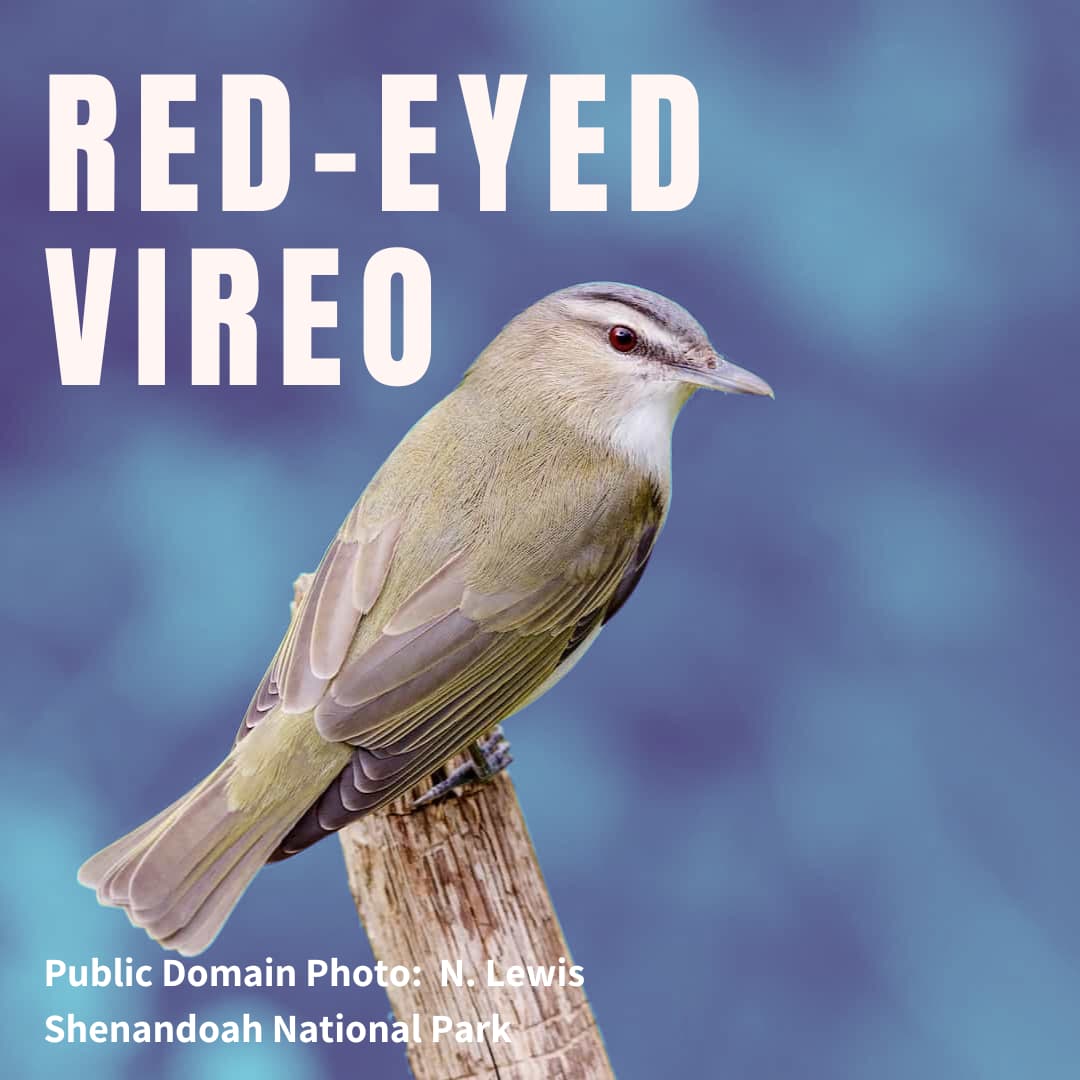
The Red-eyed Vireo is North America’s most prolific vocal marathoner, capable of delivering over 20,000 songs in a single day. Known as the “preacher bird” for its relentless midday sermons, this canopy-dwelling species represents a rare conservation success, maintaining a massive, stable population of 130 million breeding adults across the continent.3
The Midday Monopoly: A Hook in the Heat
Walk into any Eastern deciduous forest on a sweltering July afternoon, and you will encounter a curious acoustic phenomenon. While the thrushes have retreated to the shadows and the warblers have fallen into a siesta-induced silence, one voice remains. It is a persistent, rhythmic, almost clinical series of short phrases that seem to keep pace with the shimmering heat. This is the Vocal Marathoner’s Paradox: the most abundant bird in the forest is often the one we most easily ignore because its presence is so constant it becomes part of the atmospheric pressure.
To the casual observer, the Red-eyed Vireo (Vireo olivaceus) is merely a ghost in the green—a drab, olive-backed figure moving with agonizing deliberation through the highest reaches of the canopy. But to the history of ornithology, this bird represents the bridge between the poetic appreciation of the 19th century and the rigorous quantification of the 20th. It is the species that transformed a Swedish aristocrat living in a remote Canadian log cabin into a scientific revolutionary.
John Burroughs, writing in the late 1800s, recognized this bird’s unique stamina long before the era of stopwatches and data sheets. He noted its presence among its kin, observing: “There are five species found in most of our woods, namely, the red-eyed vireo, the white-eyed vireo, the warbling vireo, the yellow-throated vireo, and the solitary vireo, the red-eyed and warbling being most abundant, and the white-eyed being the most lively and animated songster.” Quote ID: 8-037 Yet, even Burroughs could not have guessed the sheer scale of the “preacher’s” endurance until a woman named Louise de Kiriline Lawrence sat beneath a nest in 1952 and began to count.
Quick ID: The Red-eyed Vireo at a Glance
| Feature | Specification |
| Scientific Name | Vireo olivaceus |
| Length | 4.7–5.1 inches (12–13 cm) |
| Weight | 12–26 grams (Approx. the weight of a AAA battery) |
| Iris Color | Deep ruby red (Adults); Grayish-brown (Juveniles) |
| Key Markings | Gray crown, bold white eyebrow (supercilium) bordered by black lines |
| Nesting | Pensile (hanging) cup in a fork of a branch |
| Song Pattern | Short 2-3 note phrases; “Question-and-answer” rhythm |
Identification: The Masked Aristocrat of the Canopy
Identifying a Red-eyed Vireo is often an exercise in patience. Because they spend the vast majority of their lives in the “upper third” of the forest, you are more likely to develop “warbler neck” than you are to get a clear look at their namesake feature.1 However, when the bird does descend—usually during a low-altitude foraging bout or while tending to a pensile nest—the facial pattern is unmistakable.
The Red-eyed Vireo is a study in olive and slate. Its back is a soft, mossy green that provides perfect camouflage against the sun-dappled leaves of a maple or beech. Its underparts are a crisp, clean white, lacking the yellow wash found in several of its cousins. The most diagnostic feature is the head: a slate-gray cap sits atop a bold white stripe that runs over the eye. This white eyebrow is sandwiched between two thin black lines—one passing through the eye and one bordering the gray crown. This creates a “masked” appearance that gives the bird an air of focused intensity.
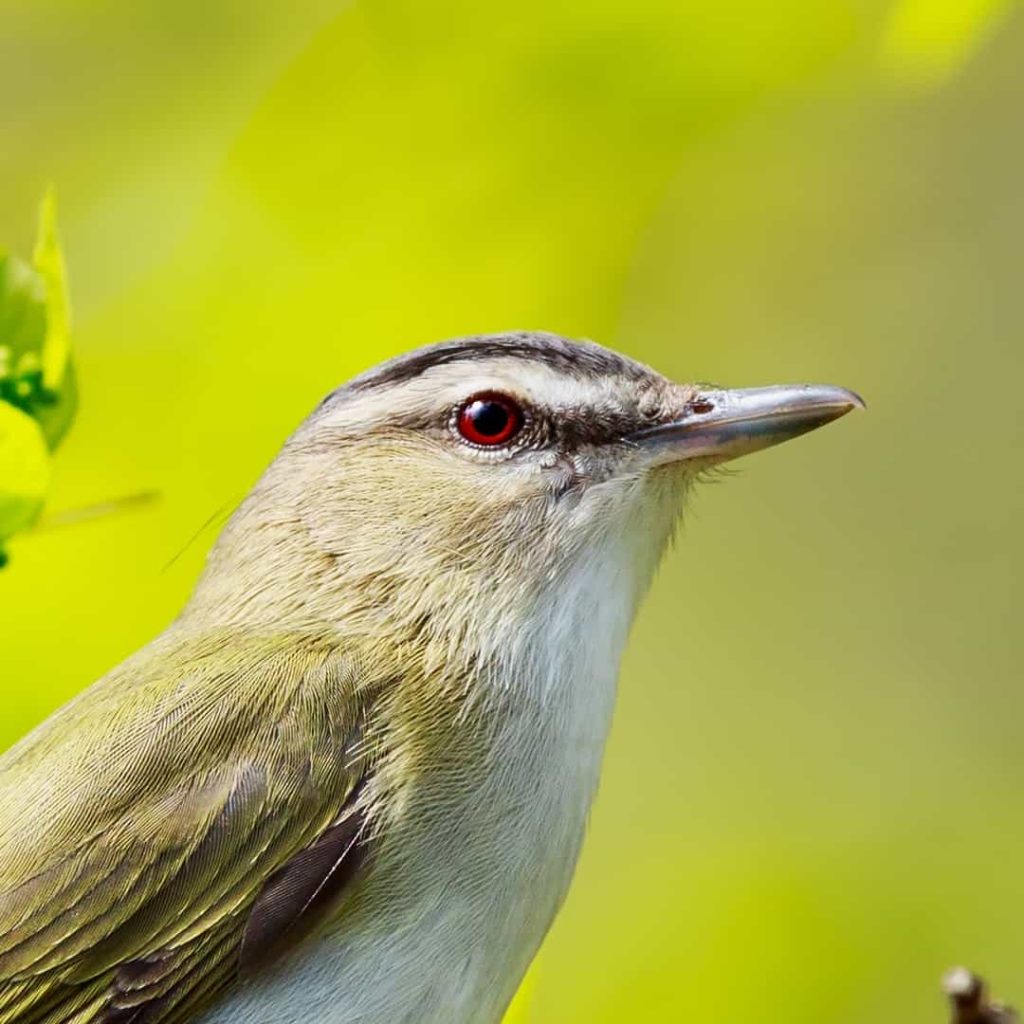
The red iris itself—the “ruby” of the vireo—is a mark of maturity. The Eye Color Maturation Timeline is a critical tool for field researchers; hatch-year birds possess a dull, grayish-brown iris that does not transition to the vibrant red of adulthood until their first winter spent in the Amazon basin.5 If you see a vireo with the correct facial markings but dark eyes in August, you are likely looking at a bird that hasn’t yet seen its first migration.
Burroughs, though writing before modern optics were commonplace, accurately noted the physical distinction of the species: “The red-eye is a larger, slimmer bird, with a faint bluish crown, and a light line over the eye.” Quote ID: 2-004 He also acknowledged the difficulty of the primary field mark, noting that “the iris of this bird is white, as that of the red-eyed is red, though in neither case can this mark be distinguished at more than two or three yards.” Quote ID: 8-044
The bill of the Red-eyed Vireo is also a departure from the daintiness of the warblers. It is relatively heavy, with a distinct hook at the tip of the upper mandible—a tool designed for gripping and crushing large caterpillars and small fruits.1 This bill, combined with their sluggish, methodical movement, distinguishes them from the “twitchy” energy of most canopy dwellers.
Vocalization: The 22,197-Song Marathon
If the Red-eyed Vireo has a superpower, it is its refusal to stop talking. This behavior earned it the nickname “Preacher Bird,”a title that highlights its relentless midday sermons. Burroughs captured the auditory landscape of the forest edge with this bird as the soundtrack: “I hear all along the line of the forest the incessant warble of the red-eyed vireo, cheerful and happy as the merry whistle of a schoolboy.” Quote ID: 1-042.
The song itself is not a complex melody like that of the Wood Thrush. Instead, it is a series of short, abrupt phrases delivered with a conversational cadence. Ornithologists often use the mnemonic “Here I am… over here… see me?… I’m up here” to describe the rhythm.4 There is a distinct “Question-and-Answer” quality to the delivery; one phrase ends on a rising note (the question), followed by a phrase that ends on a descending note (the answer).
This acoustic pattern can be heard in the Macaulay Library recording ML553426, which illustrates the 2-second interval between phrases.10
While a single song type might seem repetitive, modern bioacoustics has revealed a surprising depth to the preacher’s repertoire. A single male may possess over 30 unique song types, and across the entire species range, researchers have documented more than 12,500 distinct song variations.7 This variety may be the key to their vocal endurance, preventing the “vocal fatigue” that silences other species by midday.
The bird’s ubiquity is its defining trait. As Burroughs observed: “He is one of our most common and widely distributed birds. Approach any forest at any hour of the day, in any kind of weather, from May to August, in any of the Middle or Eastern districts, and the chances are that the first note you hear will be his.” Quote ID: 2-002
Biology and Behavior: The Canopy Method
Watching a Red-eyed Vireo forage is like watching a jeweler inspect a diamond. Unlike the American Redstart, which flits and tumbles after flying insects, the vireo is a practitioner of The Canopy Method: a slow, deliberate hopping from branch to branch, punctuated by long pauses where the bird tilts its head to scan the undersides of leaves.1
Burroughs described this methodical search with great precision: “You may see him hopping among the limbs, exploring the under side of the leaves, peering to the right and left, now flitting a few feet, now hopping as many, and warbling incessantly, occasionally in a subdued tone, which sounds from a very indefinite distance.” Quote ID: 2-005 They are searching for “slow-moving” protein—primarily caterpillars, beetles, and cicadas—which they pluck with a sudden, decisive lunge. Burroughs even noted their feeding etiquette: “When he has found a worm to his liking, he turns lengthwise of the limb and bruises its head with his beak before devouring it.” Quote ID: 2-006
In late summer and during migration, their diet shifts significantly toward vegetable matter. They become avid consumers of berries, including spicebush, elderberry, and dogwood.8 This shift is essential for building the fat reserves necessary for their 3,000-mile journey to the South American tropics.
The Architecture of the Fork
The nesting behavior of the Red-eyed Vireo is equally distinctive. While many birds build on top of a branch, the vireo builds between one. They seek out a horizontal fork at the end of a branch and weave a pensile (hanging) cup. This nest is a marvel of avian engineering, constructed from strips of bark, grasses, and rootlets, all bound together with the sticky silk of spiderwebs and caterpillar cocoons.4
Burroughs frequently stumbled upon these structures: “As I was about leaving the woods my hat almost brushed the nest of the red-eyed vireo, which hung basket-like on the end of a low, drooping branch of the beech.” Quote ID: 4-120 He further noted: “The basket-like nest, pendent to the low branches in the woods… is, in most cases, the nest of the red-eyed, though the solitary constructs a similar tenement, but in much more remote and secluded localities.” Quote ID: 8-045
One of the most remarkable behavioral traits of the species is their reaction to intruders near the nest. Unlike many birds that dive-bomb or alarm-call aggressively, the Red-eyed Vireo maintains a chillingly calm presence. Burroughs marveled at this: “Most birds exhibit great alarm and distress, usually with a strong dash of anger, when you approach their nests; but the demeanor of the red-eyed, on such an occasion, is an exception to this rule. The parent birds move about softly amid the branches above, eying the intruder with a curious, innocent look, uttering, now and then, a subdued note or plaint, solicitous and watchful, but making no demonstration of anger or distress.” Quote ID: 8-047
The Conservation Arc: The Swedish Aristocrat’s Ledger
I. The Context: The Silent Billions
For much of the 19th century, the Red-eyed Vireo was viewed through the lens of romantic abundance. To naturalists like Burroughs, the bird was an atmospheric constant—a symbol of the “indefatigable” spirit of the American wilderness. At the time, the forests of the East were recovering from the massive deforestation of the early colonial era. As second-growth forests matured, the Red-eyed Vireo population surged.
However, “abundance” in the 1800s was a matter of feeling, not data. No one truly knew how many vireos there were, or exactly how much they sang. This was the era of the Historical Baseline Contrast: we knew the preacher was tireless, but we didn’t know the length of his sermon. Science lacked a baseline for the “common bird,” making it impossible to measure future declines or successes.
II. The Decline: The Silent Shift in the West
While the overall population of Red-eyed Vireos is stable, the species faces regional challenges that reveal the fragility of even the most abundant birds. In the Western United States and parts of Washington state, the species has seen localized declines of over 3% annually.6 These declines are often tied to habitat fragmentation and the loss of riparian corridors.
A significant threat to individual reproductive success is the Brown-headed Cowbird. Because Red-eyed Vireos build accessible, open nests, they are primary targets for brood parasitism.9 In some regions, parasitism rates can exceed 50%. While this hasn’t yet translated into a continental population crash, it serves as a constant pressure on the species’ “industry and contentment” that Burroughs so admired. Quote ID: 2-095
III. The Recovery: The Quantification by Louise de Kiriline Lawrence
The transition from anecdote to data arrived in the form of Louise de Kiriline Lawrence. Born into the Swedish aristocracy and having served as a Red Cross nurse during the Russian Revolution, Lawrence eventually found herself in a remote log cabin on the Mattawa River in Ontario.2 There, she transitioned from nursing the famous Dionne Quintuplets to the obsessive study of the birds in her backyard.
In 1952, Lawrence undertook a study that would set an unbreakable record in the annals of ornithology. On May 27, she focused her attention on a single male Red-eyed Vireo. Armed with a mechanical counter and a thermos of coffee, she sat in the woods for 14 hours.4 She didn’t just listen; she tallied every single phrase the bird uttered.
The final count was staggering: 22,197 songs.4
At the height of his performance, the male was delivering 40 phrases per minute. This was more than a Guinness World Record; it was a revolution in how we understood avian energy expenditure. Lawrence’s work proved that even a “common” bird was performing feats of biological endurance that challenged the limits of physiology. Her meticulousness earned her the Burroughs Medal and made her the first Canadian woman elected as an elective member of the American Ornithologists’ Union.2 She provided the world with its first true baseline for the species.
IV. Current Status: A Rare Success Story
Today, the Red-eyed Vireo is a rare bright spot in the otherwise grim landscape of migratory bird trends. While North America has lost nearly 3 billion birds since 1970, the Red-eyed Vireo has actually increased its population by approximately 0.6% annually between 1966 and 2019.3 There are currently an estimated 130 million breeding adults.
The vireo’s success validates the work started by Lawrence. Because she established what a “thriving” vireo looked like in 1952, modern scientists can confidently say that the species remains within its historical margins. The Red-eyed Vireo serves as a case study for The Baseline of Abundance. In conservation, we often focus on the rare and the vanishing. But Lawrence understood that you cannot protect a forest if you do not understand its most successful inhabitants.
The preacher continues to pipe because the cathedral—the vast, interconnected forests of the North—remains standing. Even in the deep wilderness, his voice remains a constant. As Burroughs noted of his time in the forest: “In the deep wilds of the Adirondacks, where few birds are seen and fewer heard, his note was almost constantly in my ear.” Quote ID: 2-003
Comparison Species: The Plain-Winged Vireo Complex
The Red-eyed Vireo is often confused with other “drab” canopy dwellers. Use the following table to distinguish the “Preacher” from its look-alikes.
| Species | Key Differences from Red-eyed Vireo | Eye Color | Song Style |
| Philadelphia Vireo | Yellow wash on throat/breast; no black border on eyebrow.1 | Dark | Nearly identical to Red-eyed. |
| Warbling Vireo | Lacks facial stripes; overall “drab” gray-brown appearance.1 | Dark | Rapid, liquid warble (not phrases). |
| Tennessee Warbler | Smaller, thinner bill; no hook; daintier foraging style.1 | Dark | High-pitched, three-part staccato. |
FAQ: Understanding the Preacher
How can I identify a Red-eyed Vireo if I can’t see its red eyes?
Focus on the head pattern. The bold white eyebrow (supercilium) bordered by black lines is the most reliable field mark. Also, listen for the “question-and-answer” song delivered at 2-second intervals.1
Why does the Red-eyed Vireo sing so much more than other birds?
This is known as The Midday Monopoly. While other birds stop singing to conserve energy in the heat, the Red-eyed Vireo continues to vocalize to defend its territory and maintain pair bonds. Its simple, short song phrases are thought to be less energy-intensive than the complex melodies of thrushes or warblers.4
When does the Red-eyed Vireo’s eye color change from brown to red?
The transition occurs during the bird’s first winter. Juveniles hatched in June will have grayish-brown eyes during their first autumn migration and will return from South America the following spring with the signature ruby-red iris.5
Where do Red-eyed Vireos go in winter?
They are long-distance migrants that winter in the upper Amazon basin of South America, including parts of Brazil, Colombia, and Peru.8
What is “The Preacher Bird” nickname based on?
It stems from both the bird’s tireless delivery (like a long-winded sermon) and its physical behavior. Observers noted that the bird often turns its head from side to side as it sings, mimicking the movements of a public speaker addressing an audience.4
Do Brown-headed Cowbirds affect Red-eyed Vireo populations?
While they are a major host species and often lose individual broods to cowbird parasitism, the overall Red-eyed Vireo population is so large and stable that cowbirds do not currently pose a threat to the species’ long-term survival.9
Key Takeaways
- Vocal Record: Louise de Kiriline Lawrence documented a single male singing 22,197 times in 14 hours—a testament to avian endurance.4
- The Preacher’s Rhythm: The song is defined by a “question-and-answer” cadence that persists even in the midday heat.10
- Diagnostic Head Pattern: The ruby eye is iconic, but the white eyebrow bordered by black lines is the most reliable way to identify the species in the canopy.1
- Conservation Success: With 130 million adults and a stable to increasing trend, the Red-eyed Vireo is a rare example of a migratory success story.3
- Common Species Value: The vireo teaches us that scientific breakthroughs—like Lawrence’s—often happen when we pay closer attention to the birds in our own backyards.2
- Pensile Architecture: Their hanging nests, woven with spider silk, are marvels of the forest’s lower and mid-canopy layers.4
Bibliography
Modern Sources
1 Cornell Lab of Ornithology. (2024). Red-eyed Vireo Identification. https://www.allaboutbirds.org/guide/Red-eyed_Vireo/id
2 Ontario Heritage Trust. (2022). Louise de Kiriline Lawrence. https://www.heritagetrust.on.ca/pages/programs/provincial-plaque-program/provincial-plaque-background-papers/louise-de-kiriline-lawrence
3 Minnesota Breeding Bird Atlas. (2020). Red-eyed Vireo (Vireo olivaceus). https://mnbirdatlas.org/species/red-eyed-vireo/
4 Cornell Lab of Ornithology. (2024). Red-eyed Vireo Life History. https://www.allaboutbirds.org/guide/Red-eyed_Vireo/overview
5 McGill Bird Observatory. (2021). Red-eyed Vireo (REVI) Identification Guide. https://www.migrationresearch.org/mbo/id/revi.html
6 Wyoming Game and Fish Department. (2017). Red-eyed Vireo Species Account. https://wgfd.wyo.gov/media/7653/download?inline
7 Travis Audubon. (2023). Bird of the Week: Red-eyed Vireo. https://travisaudubon.org/murmurations/bird-of-the-week-red-eyed-vireo
8 National Audubon Society. (2024). Guide to North American Birds: Red-eyed Vireo. https://www.audubon.org/field-guide/bird/red-eyed-vireo
9 NestWatch. (2023). Brown-headed Cowbirds: The Nest Invaders. https://nestwatch.org/learn/general-bird-nest-info/brown-headed-cowbirds/
10 Cornell Lab of Ornithology Macaulay Library. Red-eyed Vireo Song. Recording ID 553426. https://macaulaylibrary.org/asset/534426
Historical Sources
Return of the Birds: A John Burroughs Wake-Robin Revival (2022) 44from26.
- Quote 2-001: The schoolboy warble. Source
- Quote 2-005: Foraging behavior. Source
- Quote 4-120: Hat brushing the nest. Source
- Quote 8-037: Kinship and abundance. Source
- Quote 8-047: Demeanor at the nest. Source