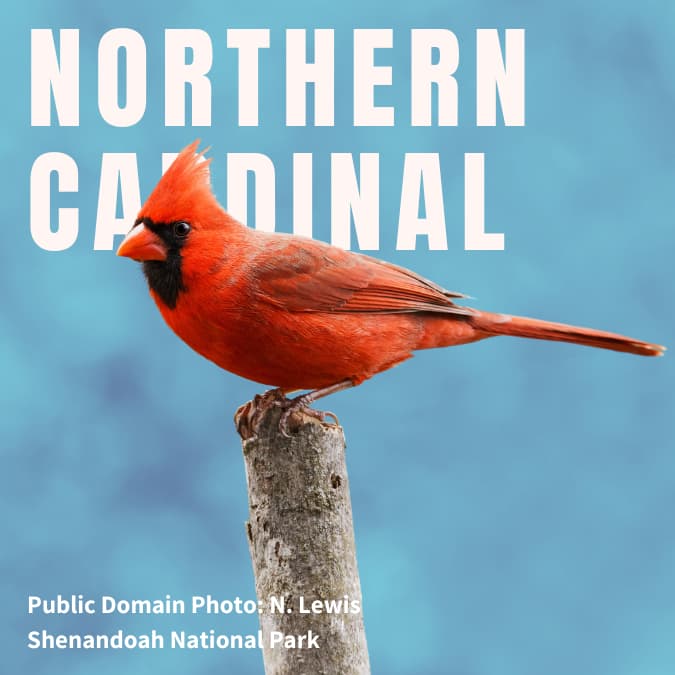
The Northern Cardinal (Cardinalis cardinalis) transformed from a prized cage bird into one of North America’s greatest conservation success stories. Once legally trapped and sold throughout the eastern United States, it became a non-migratory beneficiary of the 1918 Migratory Bird Treaty Act—and has since expanded its range from the mid-Atlantic to Canada.
The Bird That Doesn’t Negotiate
The cardinal doesn’t negotiate his entrance. He arrives in January, blood-red against a gray sky, and lands on the highest branch available—a dead elm, a utility wire, a snow-covered fence post. Then he sings. The song carries through cold air that muffles everything else, a series of loud, clear whistles that the Chesapeake Bay watermen used to transcribe as what-cheer, what-cheer and purty-purty-purty.
John Burroughs wrote that he wanted to present “a live bird—a bird in the woods or the fields—with the atmosphere and associations of the place, and not merely a stuffed and labeled specimen” Quote ID: P-006. The cardinal makes that easy. A bird this conspicuous, this unwilling to be inconspicuous, practically presents itself.
In 1871, Burroughs encountered the cardinal as a southern species, largely absent from his Hudson Valley territory. He noted that “the cardinal grosbeak, or Virginia redbird, is quite common in the same localities, though more inclined to seek the woods” Quote ID: 5-053 —”the same localities” meaning the mid-Atlantic states, not the Northeast. The cardinal was not a bird Burroughs heard every morning. Today, his great-great-grandchildren feed cardinals sunflower seeds in Vermont.
That shift—from southern specialty to continental resident—is not a natural story. It’s a legal one.
Identification: Northern Cardinal
Quick ID Box
| Feature | Male | Female |
|---|---|---|
| Size | 8–9 in (21–23 cm) | Same |
| Weight | 1.5–1.7 oz (42–48 g) | Same |
| Body color | Brilliant crimson red, entirely | Warm brown, red-tinged crest, wings, tail |
| Face mask | Bold black from forehead to throat | Gray to black, less defined |
| Bill | Heavy, conical, orange-red | Same |
| Crest | Prominent, raised when alert | Prominent, same |
| Wings | Red with darker flight feathers | Reddish-brown |
Visual Description
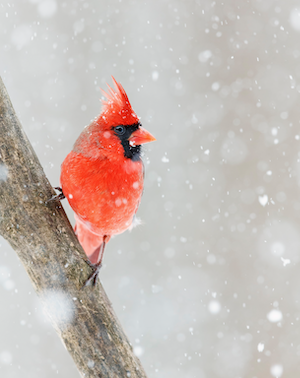
No other crested bird in eastern North America is entirely red. That sentence alone identifies the adult male Northern Cardinal in almost any context3. The combination—solid red body, black mask, heavy orange bill, tall pointed crest—is unambiguous whether the bird is perched, flying, or half-buried in a snow-covered shrub.
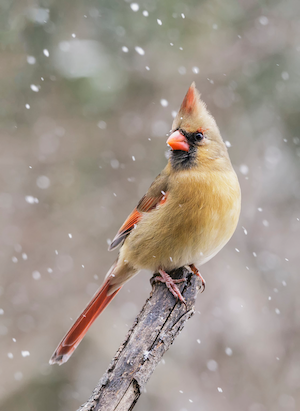
The female is a different proposition. Burroughs got her right in 1871: “the female is tinged with brown, and shows but little red except when she takes flight” Quote ID: 5-078. The warm reddish-brown base coat, red-washed crest, wings, and tail, and the same heavy orange bill as the male are the field marks to memorize. New birders sometimes mistake her for a House Finch or a wren—until they notice the crest, the bill size, and the reddish flush that Burroughs observed across 150 years ago1.
The distinctive crest functions as a mood indicator. Raised and pointed means alert or agitated. Lowered and nearly flat means relaxed. Cardinals at feeders in winter often move through the full range in seconds.
A note on naming: before the American Ornithologists’ Union standardized the name “Northern Cardinal” in 1983, the bird appeared in field guides and literature as the “Kentucky Cardinal,” “Virginia Nightingale,” “Redbird,” and “Cardinal Grosbeak.” Burroughs’s “Virginia redbird” was not unusual terminology for the era.
Field Marks Summary
The cardinal is one of the few birds where the heavy, conical bill actually narrows the identification rather than opening it up. That bill—built for cracking seeds, large enough to split a sunflower seed with a single bite—belongs to exactly one crested, red bird in eastern North America3.
One in approximately one million Northern Cardinals carries a genetic mutation called xanthochromism that blocks the enzyme (CYP2J19) responsible for converting yellow dietary carotenoids into red pigments12.

The result is an entirely yellow cardinal—same shape, same crest, same bill—but golden rather than scarlet. About three such birds are reported annually across the continent, per the National Audubon Society12. If you find one, you’ll know.
Vocalization: The Fife, the Sabre, and the Duet
Burroughs described the cardinal’s voice as having “something of the tone of the fife in his song or whistle, while his ordinary note, when disturbed, is like the clink of a sabre” Quote ID: 5-054. The fife comparison holds. The song is bright, penetrating, and clean—a series of slurred whistles that carry farther than most songbirds of comparable size. The sabre-clink is the sharp metallic chip call that cardinals deploy constantly for alarm, territory warning, nest approach, and nestling management2.
Scientists have documented at least 16 distinct calls in the Northern Cardinal’s vocal repertoire2. Most birders encounter three or four regularly: the loud territorial song, the metallic chip alarm, a softer took contact note used between mates, and the song the female sings from the nest.
The Female’s Signature
Here is where the cardinal departs from the songbird norm, and the departure is significant.
Among North American songbirds, female song is rare. Most species leave the vocal work to males. The female Northern Cardinal does not follow this convention. She sings—often while sitting directly on the nest—and her song tends to be longer and slightly more complex than the male’s1.
The research on this behavior, traced through field studies including Sylvia Halkin’s 1990 dissertation on intrapair communication and her 1997 Animal Behaviour paper, suggests that nest-vicinity song exchanges coordinate biparental care: when the female sings from the nest, she may be signaling the male about when to bring food2.
Mated pairs share song phrases. They also duet—singing coordinated back-and-forth exchanges that researchers describe as strengthening pair bonds and potentially aiding in mate recognition2.
This vocal coordination between mates is rare enough among temperate songbirds that it qualifies as one of the Northern Cardinal’s most scientifically notable characteristics. It is also, once you know to listen for it, one of the more striking things you will hear from a suburban hedgerow in May.
Call Notes
The sharp metallic chip is the call you will hear most often. Cardinals produce it when warning off intruders, when predators approach, as females move to and from the nest, and by both sexes when carrying food to nestlings2. A rapid, agitated series of chips is the cardinal equivalent of a fire alarm. When you hear it, look for a cat, a Cooper’s Hawk, or a rat snake.
Behavior and Biology
Foraging and Diet
Cardinals are primarily granivores that supplement their diet with insects and fruit, adjusting the ratio seasonally1. They forage mostly on the ground or in low vegetation, hopping through cover rather than flying through it. At feeders, they show a strong preference for black oil sunflower seeds—which suit the heavy conical bill’s seed-cracking design3. Safflower seeds are a close second, with the added benefit that squirrels tend to avoid them.
The red that makes the male cardinal unmistakable comes directly from his diet. Cardinals cannot synthesize red pigments internally; they manufacture them by metabolically transforming four yellow and orange carotenoids ingested through food—lutein, zeaxanthin, β-cryptoxanthin, and β-carotene—into red keto-carotenoids deposited in growing feathers10. Males with access to more carotenoid-rich foods during molt develop brighter plumage. Research has found that redder males tend to provide more parental care and occupy higher-quality territories10. The red is not decoration. It is a metabolic report.
This carotenoid-to-red conversion happens during molt. Cardinals molt once per year, typically in late summer. Most of the molt is gradual. The head molt is not—many individuals lose all their head feathers simultaneously, spending approximately one week with naked black skin where the crest should be11. This simultaneous head molt is considered within the normal range for Northern Cardinals and Blue Jays, and is not a sign of disease. The bird at your feeder that looks like it lost an argument with a pair of scissors is fine.
Nesting Cycle
The female builds the nest alone, selecting sites 1 to 15 feet high in dense foliage—vine tangles, hawthorn, honeysuckle, rose bushes, and blackberry brambles are favored1. The finished nest has four distinct layers: coarse twigs, a leafy mat, grapevine bark lining, and a final interior of fine grasses and rootlets. Construction takes 3 to 9 days1.
Cardinals raise 2 to 3 broods per year, each with 2 to 5 eggs incubated for approximately 11 to 13 days3. The male feeds the female throughout incubation—the courtship feeding that begins in spring never entirely stops. While the female incubates, the male actively defends the territory, which brings us to the window-striking behavior that confounds homeowners each spring: male cardinals attack reflections in windows, car mirrors, and polished bumpers, interpreting the image as a rival male1. This can persist for weeks. The reflection does not get tired of fighting and leave. The male does not figure out what he’s fighting. Both individuals, in a sense, lose.
Cardinals typically don’t reuse nests between seasons1. Most individuals spend their entire lives within a mile of where they were hatched. This is a bird that stays.
Social Structure
Cardinals move in pairs during breeding season and join loose flocks of up to several dozen individuals in fall and winter1. These winter flocks have a social hierarchy: adults yield to other adults by sex (females give way to males in feeding order), but juveniles give way to adults regardless of sex. Cardinals frequently forage alongside Dark-eyed Juncos, White-throated Sparrows, and Tufted Titmice at winter feeders. Up to 20 percent of mated pairs separate before the following breeding season1. When one member of a breeding pair dies, the remaining bird typically finds a new mate within days.
Conservation: Historical Baseline (Burroughs Era)
In the mid-nineteenth century, the Northern Cardinal was a southern and mid-Atlantic species. Burroughs, writing from the Hudson Valley, placed it in the same localities as mockingbirds and other southern birds—”quite common” in those areas, but absent from the northeastern forests where he did most of his walking7. The species’ core range ran from the Gulf Coast northward through Pennsylvania and New Jersey, with only scattered populations reaching southern New York7.
What Burroughs did not write about—because it was unremarkable in his era—was the trade in live cardinals as cage birds. The Northern Cardinal was among the most prized cage birds in the eastern United States during the nineteenth and early twentieth centuries. The male’s brilliant red plumage and its complex, persistent song made it commercially valuable. Dealers trapped cardinals legally, selling them to households that kept them in parlor cages the way households today keep tropical fish. The cardinal was, in the language of the trade, a “Virginia Nightingale”—the kind of common name that signals a bird expensive enough to have a marketing name.
Burroughs could observe, accurately, that “the presence of man has exerted a very marked and friendly influence upon them, since they so multiply in his society” Quote ID: 1-057. He was describing the cardinal’s tolerance of agricultural edges and human settlement. He could not have known that within decades, human society’s relationship to the bird would shift from consumer to protector—and that the protection would unlock an expansion no one anticipated.
Conservation: The Decline
The cage bird trade exerted localized, but real, pressure on cardinal populations, particularly in areas where trapping was concentrated, and birds were shipped in volume. The species was never at risk of continental extinction—its core range in the Southeast was too large and too stable for that—but population depletion in captured areas was documented, and the commercial incentive to trap birds was not self-limiting. More trapping meant fewer birds available, which raised prices and incentivized more trapping.
By 1929, ornithologist Edward Howe Forbush described the cardinal as rare in Massachusetts7. This was partly a natural range boundary—cardinals genuinely were at the northern edge of their range in southern New England—but the cage trade had contributed to reducing even those peripheral populations. The bird that a generation later would become the most recognized songbird in North America was, in much of New England, essentially unknown.
The broader context was the millinery trade’s destruction of American bird populations throughout the 1880s and 1890s. The fashion industry’s demand for bird plumage—not just feathers but whole stuffed birds mounted on women’s hats—was killing an estimated 200 million birds per year5. Herons, egrets, and terns bore the worst of it, but the trade’s appetite touched dozens of species. The cardinal, valuable as a live bird rather than a feathered ornament, faced a parallel but distinct pressure.
The Weeks-McLean Migratory Bird Act of 1913 attempted to address the problem but was struck down by federal courts as unconstitutional3. The legal machinery for bird protection didn’t yet exist in a form that could withstand challenge. What was needed was a treaty, which would carry federal authority courts couldn’t override.
The migratory bird irony was already taking shape: the bird that would become one of the greatest beneficiaries of federal protection was a species that didn’t migrate at all.
Conservation: The Recovery
On July 3, 1918, President Woodrow Wilson signed the Migratory Bird Treaty Act into law, implementing a 1916 treaty between the United States and Great Britain (on behalf of Canada)5. The Act made it a federal crime to pursue, hunt, take, capture, kill, or sell any protected native bird or its parts, nests, or eggs5. Penalties included fines up to $15,000 and potential imprisonment5. The cage bird trade ended abruptly for every species on the protected list.
The Northern Cardinal is not a migratory bird. It does not have a separate breeding range and wintering range that it travels between seasonally. Cardinals spend their entire lives within roughly a mile of where they hatched. The MBTA was designed to protect birds crossing international borders. The cardinal doesn’t cross borders.
It doesn’t matter. The Act has been interpreted to protect any bird that naturally occurs in the United States or its territories, migratory or not5. The “migratory” in the title became, as ornithological law scholar Audubon has noted, largely symbolic—the law protects resident species with equal force. A cardinal enjoys the same protection as a Blackpoll Warbler, a bird that travels 1,700 miles over open ocean each fall.
With legal protection in place, cardinal populations recovered and began pushing outward. The Northward Drift had actually begun before the MBTA—range expansion into Ohio was documented in the 1830s—but the removal of trapping pressure allowed the expansion to accelerate in areas previously suppressed7. By 1955, ornithologist Ludlow Griscom reported the cardinal “pushing northward” when it appeared annually at Massachusetts feeding stations7.
- The first confirmed nesting in Massachusetts occurred in 1958
- The first confirmed nesting in New Hampshire came in Hanover in 19606
- The first Quebec nesting followed in 19657
This expansion unfolded against a backdrop of three reinforcing trends: warming winters that reduced snow depth and made ground foraging more viable year-round; suburban development fragmenting forest into the brushy edge habitat cardinals prefer; and a growing culture of backyard bird feeding that provided reliable winter food in latitudes where cardinals had previously been unable to survive cold seasons7.
Tracking this expansion required a Citizen Science Revolution that was itself just coming into being. In 1967, New Hampshire Audubon launched its Backyard Winter Bird Survey (BWBS), specifically prompted by the increasing numbers of cardinals, Tufted Titmice, and Northern Mockingbirds appearing at Granite State feeders6. The nationwide Breeding Bird Survey was launched in 1966. Christmas Bird Count participation was expanding rapidly. Three independent data streams began recording what the cardinal was doing.
Then, in the winter of 1987–1988, Canadian ornithologist Dr. Erica Dunn—who had founded the Ontario Bird Feeder Survey in 1976—partnered with the Cornell Lab of Ornithology to launch Project FeederWatch9. More than 4,000 participants enrolled in the first season. The program has since grown to over 20,000 citizen scientists monitoring feeders across North America each winter9. Thirty years of FeederWatch data documented the cardinal’s expansion with precision: a growing percentage of FeederWatchers in Minnesota, Michigan, Maine, and southeastern Canada reported cardinals where none had been recorded before8. “Cardinals, like people, appreciate a free lunch,” Cornell Lab citizen science director David Bonter observed, summarizing three decades of data in a single sentence8.
The Feeder-Assisted Expansion was now documented, quantified, and visible in real time.
Conservation: Current Status
The Northern Cardinal has arrived. The global breeding population is estimated at 130 million birds1. The U.S. Breeding Bird Survey records a population trend of +0.32 percent per year since 19661. In Canada, where the species was essentially absent a century ago, BBS data show the population growing at approximately 3.8 percent per year13 —a rate reflecting the leading edge of an expansion still in progress. Partners in Flight rates the species 5 out of 20 on the Continental Concern Score, placing it among the birds of lowest conservation concern on the continent7.
Seven U.S. states have named it their official state bird3:
- Illinois
- Indiana
- Kentucky
- North Carolina
- Ohio
- Virginia
- West Virginia
No other species holds that distinction in as many states.
The cardinal that Burroughs described as “quite common in the same localities” in the mid-Atlantic now nests in Quebec, Nova Scotia, and New Brunswick. It winters at feeders in Vermont, Minnesota, and southern Ontario. It is, by any measure, one of the most abundant and successful songbirds in North America—and it got there through the combined effect of legal protection, suburban development, climate warming, and millions of people filling feeders with sunflower seeds.
Alanis Morrisette can use this because it’s ironic: A non-migratory species became one of the defining conservation success stories of the law designed to protect migratory birds. Plus, for what it’s worth, we love Jagged Little Pill.
Similar Species: How to Tell Them Apart
| Species | Key Differences from Northern Cardinal | Bill | Range Overlap |
|---|---|---|---|
| Pyrrhuloxia (Cardinalis sinuatus) | Males gray-brown with rose-red accents rather than solid red; same crest shape | Stubby, curved, yellow — parrot-like vs. cardinal’s straight orange-red | Desert scrub of AZ, NM, TX; decisive overlap only in extreme south TX and AZ |
| Summer Tanager (Piranga rubra) | Adult male all rose-red but NO black face mask, NO crest; female olive-yellow, not warm brown | Longer, thinner, yellowish vs. cardinal’s massive bill | Broad eastern/central U.S. overlap; unlike cardinal, a neotropical migrant |
| House Finch (Haemorhous mexicanus) | Much smaller, rounded head (no crest); heavily streaked brown throughout; male’s red limited to head, breast, rump | Small finch bill | Entire cardinal range; most common feeder confusion species for new birders |
FAQ: Common Questions About Northern Cardinals
1. Why is the male Northern Cardinal bright red but the female is brown?
The difference comes down to genetics and natural selection. Males need to be visible—bright red plumage signals health, territory dominance, and mate quality to both rival males and potential mates10. Females need to be invisible while incubating eggs in a nest that a sharp-eyed predator could find. The warm brown with reddish highlights is camouflage that also maintains enough of the species’ color signature to keep pair recognition intact1.
2. Do female Northern Cardinals sing, or is it only the males?
Both sexes sing—and the female’s song is often longer and slightly more complex than the male’s1. Female cardinals frequently sing from the nest during incubation, which researchers believe signals the male about when to bring food. Mated pairs share song phrases and engage in coordinated duets that appear to strengthen their pair bond2. Among North American songbirds, female song is rare enough that this is one of the Northern Cardinal’s most scientifically notable characteristics.
3. Why does a cardinal keep flying into my window?
During breeding season, male cardinals defend their territory aggressively. When a male sees his own reflection in a window, car mirror, or polished bumper, he interprets it as a rival male who refuses to leave1. He attacks the reflection. The reflection attacks back with equal intensity. This can continue for weeks. Covering the reflective surface from the outside or applying decals that break up the reflection will stop it. The bird is not injured. He is losing an argument with physics.
4. What seeds do Northern Cardinals prefer at bird feeders?
Black oil sunflower seeds are the top choice—the heavy conical bill cracks them efficiently1. Safflower seeds are a reliable alternative that most squirrels avoid. Cardinals also eat millet, cracked corn, and a variety of wild fruits. Platform or hopper feeders work better than tube feeders because cardinals prefer a stable surface to perch on while feeding3.
5. Why does my cardinal look completely bald — is it sick?
Almost certainly not. Northern Cardinals (and Blue Jays) frequently undergo simultaneous molting of all head feathers at once in late summer11. The result is a bird with naked black skin where the crest used to be. The condition lasts approximately one week before new feathers grow in, and it is considered within the normal range of molt variation for the species11. If the bird is otherwise active, eating, and showing no sores, scabs, or signs of lethargy, it is fine.
6. Do Northern Cardinals mate for life?
Not strictly. Most mated pairs stay together through multiple breeding seasons, but up to 20 percent of pairs separate before the following year1. When one member of a pair dies, the surviving bird typically finds a new mate quickly—sometimes within a day or two. The pair bond is strong during breeding season and winter, but it’s better described as seasonal monogamy with long-term preference than lifelong fidelity.
7. How did the cardinal expand its range into New England and Canada?
Three factors worked together: warming winters that reduced the snow cover, making ground foraging difficult; suburban development creating the brushy edge habitat cardinals prefer over mature closed-canopy forest; and the spread of backyard bird feeders providing reliable winter food in latitudes previously too cold for non-migratory birds to survive7. NH Audubon documented the first confirmed New Hampshire nesting in Hanover in 1960; Quebec followed in 19656. Project FeederWatch, launched in 1987, tracked the expansion in real time across the following decades8.
8. Why is the Northern Cardinal the state bird of 7 states?
Seven states — Illinois, Indiana, Kentucky, North Carolina, Ohio, Virginia, and West Virginia — have adopted the Northern Cardinal as their official state bird, more than any other species3. The combination of year-round residency (it doesn’t leave in winter), immediate visual recognizability, common presence at feeders and suburban areas, and the song that announces spring before most other birds have returned made it a natural candidate. It also doesn’t hurt that the male is, objectively, one of the most visually striking birds in North America.
Key Takeaways
- The Cage Bird That Escaped History: Before 1918, it was legal to trap, sell, and keep Northern Cardinals as cage birds throughout the United States. The Migratory Bird Treaty Act ended the trade and enabled the species’ recovery and expansion.
- The Migratory Bird Irony: The Northern Cardinal is one of the few non-migratory songbirds in North America, yet it became one of the primary conservation beneficiaries of a law designed to protect migratory species — because the MBTA protects all native U.S. birds regardless of migration status.
- 130 Million and Counting: Partners in Flight estimates a global breeding population of 130 million, with the Canadian population growing at approximately 3.8% per year — a rate reflecting an expansion still in progress13.
- She Sings Longer: The female Northern Cardinal typically sings a longer and more complex song than the male, often from the nest during incubation to coordinate food delivery — a behavior rare enough among North American songbirds to be scientifically significant1.
- The Burroughs Baseline: In 1871, Burroughs noted the cardinal as common only in mid-Atlantic “localities” and largely absent from the Northeast. Today it nests in Quebec and Nova Scotia. That is 150 years of documented range expansion in a species that moves roughly one mile from its birthplace.
- One in a Million: Approximately 1 in 1 million Northern Cardinals carries a genetic mutation called xanthochromism that blocks conversion of yellow dietary carotenoids to red, producing a cardinal that is entirely golden-yellow12. About three are reported annually across the continent.
- What You Can Do: Plant dense native shrubs — dogwood, hawthorn, honeysuckle, viburnum — for nesting cover, and maintain a platform feeder with black oil sunflower or safflower seeds year-round. Cardinals don’t nest in boxes, but they will nest in your yard if the cover is right.
Bibliography
Modern Scientific Sources
[1] Cornell Lab of Ornithology. (2024). Northern Cardinal Life History. All About Birds. https://www.allaboutbirds.org/guide/Northern_Cardinal/lifehistory
[2] Cornell Lab of Ornithology. (2024). Northern Cardinal Sounds. All About Birds. https://www.allaboutbirds.org/guide/Northern_cardinal/sounds
[3] National Audubon Society. (2024). Northern Cardinal Field Guide. Audubon Society. https://www.audubon.org/field-guide/bird/northern-cardinal
[4] Sauer, J. R., et al. (2019). The North American Breeding Bird Survey, Results and Analysis 1966–2019. USGS Eastern Ecological Science Center. https://www.usgs.gov/tools/north-american-breeding-bird-survey-results-and-analysis
[5] U.S. Fish & Wildlife Service. (2024). Migratory Bird Treaty Act of 1918. U.S. Fish & Wildlife Service. https://www.fws.gov/law/migratory-bird-treaty-act-1918
[6] NH Audubon. (2022). Bird of the Month: Northern Cardinal. New Hampshire Audubon Society. https://nhaudubon.org/bird-of-the-month-northern-cardinal/
[7] Pfannmuller, L., et al. (2020). Northern Cardinal (Cardinalis cardinalis). Minnesota Breeding Bird Atlas. https://mnbirdatlas.org/species/northern-cardinal/
[8] Cornell Lab of Ornithology. (2017). 30 Years of Project FeederWatch Yield New Insights About Backyard Birds. Living Bird / All About Birds. https://www.allaboutbirds.org/news/30-years-of-project-feederwatch-yield-new-insights-about-backyard-birds/
[9] Cornell Lab of Ornithology and Birds Canada. (2024). Project FeederWatch: Project Overview. https://feederwatch.org/about/project-overview/
[10] McGraw, K. J., Hill, G. E., and Parker, R. S. (2003). Carotenoid Pigments in a Mutant Cardinal: Implications for the Genetic and Enzymatic Control Mechanisms of Carotenoid Metabolism in Birds. The Condor, 105(3), 587–592. https://academic.oup.com/condor/article/105/3/587/5563381
[11] Cornell Lab of Ornithology. (2024). I Have a Bald Bird at My Feeder. Is It Sick? All About Birds. https://www.allaboutbirds.org/news/i-have-a-bald-bird-at-my-feeder-is-it-sick/
[12] Stephenson, K. (2018). Why Is This Northern Cardinal Yellow? Audubon Magazine. https://www.audubon.org/magazine/why-northern-cardinal-yellow
[13] Halkin, S. L., Shustack, D. P., DeVries, M. S., Jawor, J. M., and Linville, S. U. (2021). Northern Cardinal (Cardinalis cardinalis), version 2.0: Demography and Populations. Birds of the World. Cornell Lab of Ornithology. https://birdsoftheworld.org/bow/species/norcar/cur/demography
Historical Sources
Return of the Birds: A John Burroughs Wake-Robin Revival (2022) 44from26. (Peter Meddick, editor, 2022), audiobook on Audible.
Quote P-006: On presenting a live bird — the atmosphere and associations of the place, not a stuffed and labeled specimen. Source
Quote 5-053: The cardinal grosbeak, or Virginia redbird, quite common in the same localities — more inclined to seek the woods. Source
Quote 5-054: Something of the tone of the fife in his song — ordinary note like the clink of a sabre. Source
Quote 5-078: The female tinged with brown — shows but little red except when she takes flight. Source
Quote 1-057: The presence of man has exerted a very marked and friendly influence — they so multiply in his society. Source