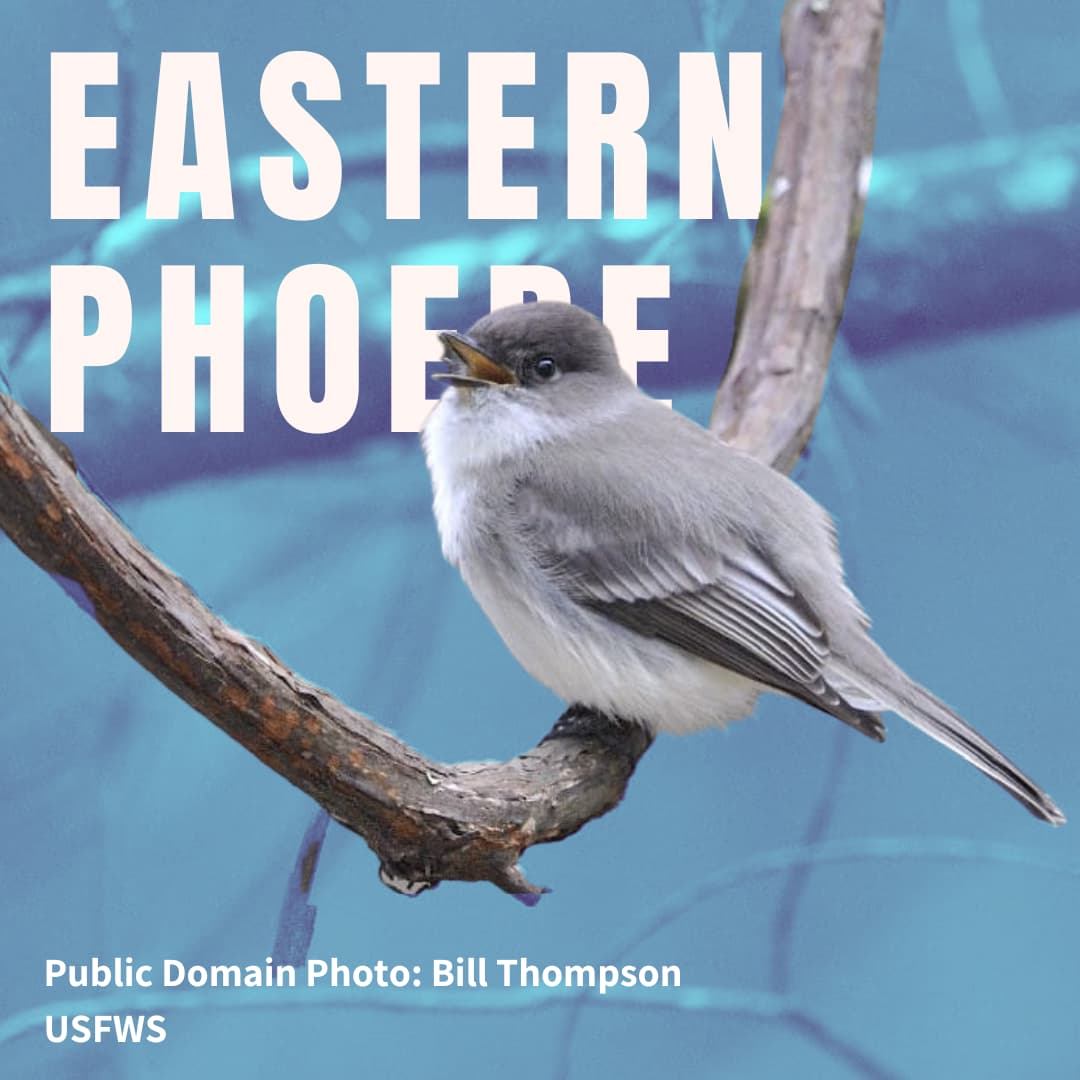
The Eastern Phoebe holds a distinction no other North American bird can claim: it was the first wild bird ever banded on the continent, the subject of an 1804 experiment by John James Audubon that launched 220 years of population science—and may have been at least partially fabricated. This plain-suited flycatcher, a sit-and-wait hunter who nests under bridges and barn eaves, is now facing a quiet threat: the very structures that replaced its original cliff-face homes are being replaced in turn.
The Bird That Started It All
In the winter of 1803, John James Audubon arrived at Mill Grove, his father’s Pennsylvania estate on Perkiomen Creek, less interested in managing the property than in watching birds. The following spring, he noticed Eastern Phoebes nesting in a cave near the water. He tied silver thread around the legs of five nestlings. He called it science.
“The phoebe bird, the pioneer of the flycatchers. In the inland farming districts, I used to notice her, on some bright morning about Easter Day, proclaiming her arrival, with much variety of motion and attitude, from the peak of the barn or hay-shed.” Quote ID: 1-033
That observation came sixty-seven years after Audubon’s banding experiment, from a bird and a landscape that had already made its peace with human infrastructure. The phoebe had not changed. What historian Matthew Halley examined in 2018 was whether Audubon’s version of what happened next was quite as reliable as the legend required.
Audubon claimed two of his five banded nestlings returned the following spring. The story became the founding act of North American bird banding — cited in textbooks, celebrated in field guides, engraved in the institutional memory of ornithology. It may not have happened the way he said. The Eastern Phoebe (Sayornis phoebe) is a plain bird that keeps remarkable company.
Quick ID: The Eastern Phoebe at a Glance
| Feature | Specification |
|---|---|
| Scientific Name | Sayornis phoebe |
| Length | 5.5–6.7 inches (14–17 cm) |
| Weight | 16–21 grams (approx. the weight of four nickels) |
| Key Markings | Brownish-gray above; off-white below with faint yellow wash; dark hood is the darkest part of the upperparts; no wingbars; no eye ring; all-dark bill |
| Signature Behavior | Continuous downward-then-upward tail pump while perched — unique among eastern flycatchers |
| Nesting | Open mud-and-moss cup under a ledge or overhang (bridge beam, barn eave, rock face); never uses enclosed cavities |
| Song Pattern | Two raspy syllables: “fee-bee”; alternates with stuttered “fee-b-be-bee” variant; rate of alternation increases with singing intensity |
Visual Description
Burroughs sized this bird up with his characteristic dry accuracy: “surely that ashen gray suit is the superlative of plainness; and that form, likewise, would hardly pass for a perfect figure of a bird.” Quote ID: 1-037
He was not wrong. The Eastern Phoebe is brownish-gray above and off-white below, with a dusky wash on the sides of the breast and a faint yellowish tinge to the belly in fresh fall plumage.1 The head is the darkest part, often appearing flat-topped, sometimes raised into a slight crest. No eye ring. No bold wingbars. An all-dark bill. It is a plump, large-headed bird that would be genuinely difficult to pick out of a gray November morning if it held still.
It does not hold still.
Field Marks
The single most reliable identification feature for this species requires no binoculars and no field guide: watch the tail. The Eastern Phoebe pumps its tail downward then upward, rhythmically, almost continuously while perched.1 No other small flycatcher in the East does this habitually. Not the Eastern Wood-Pewee, not any Empidonax flycatcher. Among eastern flycatchers, the tail-wag is uniquely, definitively the phoebe’s signature.
The Eastern Wood-Pewee (Contopus virens) is the species most likely to cause confusion. Essentially identical in size and coloration. But look for three differences: the pewee has bold, distinct wingbars; a two-toned bill with a pale lower mandible; and a tail that sits completely still.1 The Wood-Pewee also arrives weeks later — late April or May, not March — and its song, a long drawn-out pee-ah-wee, bears no resemblance to the phoebe’s raspy two-note call.
Say’s Phoebe (Sayornis saya) shares the genus and the tail-pumping habit but differs immediately in the field: buffy-orange belly, and a range west of the Great Plains. In the eastern half of the continent, a tail-pumping phoebe is an Eastern Phoebe.
Vocalization: The Bird That Sings Its Own Name
Song Description
The fee-bee is unmistakable once you’ve heard it — raspy, emphatic, two syllables, lasting about half a second.4 It sounds like the bird is announcing itself impatiently. In early March, before most other flycatchers have even left their wintering grounds, you will hear this call from a bare branch above a thawing stream, and know exactly what made it.
Eastern Phoebes do not learn their song. Unlike most songbirds, the phoebe is a suboscine flycatcher — its vocalizations are genetically encoded rather than culturally acquired. Birds raised in acoustic isolation, hearing no adult phoebes during development, grow up to sing normal phoebe songs anyway.4 The song is innate.
Males actually sing two song types, alternating them in a pattern ornithologist Donald Kroodsma documented in 1985. The first is the standard fee-bee. The second is a stuttered variant — fee-b-be-bee — with a sputtery middle section. At high singing rates (around 40 songs per minute), males alternate the two forms nearly equally; below 20 songs per minute, males sing almost exclusively the standard fee-bee.4 The stuttered variant appears most often during or after aggressive interactions.4
Call Notes
Both sexes use a sharp, clear chip or peep note year-round. Males hovering near a potential nest site to display it to a female give a nasal chattering call. An agitated phoebe — confronting a predator, an intruder, or occasionally a bird bander — will snap its bill mandibles together loudly, a percussive pop that carries farther than you’d expect from a bird this size.4
Behavior and Biology
Foraging: The Sit-and-Wait Strategy
The Eastern Phoebe is a textbook practitioner of the Sit-and-Wait Strategy. It claims a low perch — fence post, utility wire, exposed branch over water — watches for movement, then launches in a short burst to snatch a flying insect, usually returning to the same perch to wait again.1 Diet runs to wasps, beetles, dragonflies, butterflies, flies, midges, and cicadas, plus spiders, ticks, and millipedes.1 In winter, when insects are scarce, phoebes shift to small fruits and berries — one of the dietary flexibilities that lets them winter farther north than any other eastern flycatcher.
Nesting: The Niche Nester’s Logic
The Eastern Phoebe is what might be called a Niche Nester: it requires an overhang but will not use an enclosed cavity.2 This is a critical distinction from box-nesting species like bluebirds. A nest box with an entry hole is useless to a phoebe. It needs a ledge — a horizontal surface with protection above and exposure in front. Before Europeans arrived, that meant cliff faces, cave entrances, and rock outcrops. Then came the barns, bridges, and covered porches, and the phoebe followed.
“Always the freshness and coolness, and always the delicate mossy nest of the phoebe bird! The bird keeps her place till you are within a few feet of her, when she flits to a near branch, and, with many oscillations of her tail, observes you anxiously.” Quote ID: 4-133
Only the female builds the nest — a compact cup of mud, moss, and leaves mixed with grass stems and animal hair — while the male stays nearby.1 Construction takes five to fourteen days. The finished cup measures about 2.5 inches across and 2 inches deep.1 Unlike most songbirds, phoebes frequently reuse nests across seasons, sometimes building the new year’s clutch directly on top of old material. Barn Swallows occasionally occupy phoebe nests between seasons; phoebes in turn have been documented renovating old robin or swallow nests for their own use.2 Most pairs raise two broods per season. Incubation takes about 16 days, performed by the female alone; nestlings fledge at 16–18 days.
The Tail-Pump Signal
That persistent up-down tail motion has attracted genuine scientific inquiry. A 2009 study by Carder and Ritchison in the Journal of Field Ornithology tested four hypotheses — balance, territorial signaling, foraging enhancement, and predator deterrence — and found support for only one.11 Eastern Phoebes significantly increase their tail-pumping rate in the presence of a potential predator. The working interpretation: tail-pumping signals to hawks and other predators that they have been detected, advertising the phoebe’s alertness and agility. A predator with no element of surprise may not bother to attack. The phoebe is not wagging its tail because it is happy. It is telling you it has noticed you.
Social Structure and Longevity
The Eastern Phoebe is a genuine loner. Males and females of mated pairs spend little time together — the female frequently chases the male away during incubation — and both sexes typically roost alone.2 Mate fidelity is high, with in-season and between-season divorce rates below 5% in Indiana population studies. The oldest known individual reached at least 10 years and 4 months — banded in Iowa in 1979 and recovered in Alberta in 1989.2
Brown-Headed Cowbird Parasitism
Approximately 20% of Eastern Phoebe nests are parasitized by Brown-headed Cowbirds (Molothrus ater).12 Phoebes accept cowbird eggs without rejection. The cowbird chick, hatching earlier than phoebe nestlings and growing faster, outcompetes its nest-mates for food; fledgling success in parasitized nests heavily favors the cowbird at the expense of phoebe young.12 At current parasitism rates — roughly one nest in five — the impact on the overall population is manageable. But it adds sustained pressure to a species whose nest-site availability is under a separate, structural threat.
Conservation: Historical Baseline (Burroughs Era)
In 1804, at Mill Grove, Pennsylvania, John James Audubon tied silver thread around the legs of five Eastern Phoebe nestlings and waited. The following spring, he claimed two of the banded birds had returned to nest nearby. The story became the founding act of North American bird banding — cited across two centuries of ornithological literature as the moment population science began on this continent.
“The phoebe-bird is the pioneer of the flycatchers, and comes in April, sometimes in March. It comes familiarly about the house and outbuildings, and usually builds beneath hay-sheds or under bridges.” Quote ID: 8-050
Burroughs wrote that in 1871, from the Hudson Valley, describing a bird thriving in the human landscape — common on farms and bridges across the rural Northeast. The phoebe Burroughs knew was abundant, trusting, and growing more so as European settlement spread infrastructure across the eastern continent. The species had traded cliff faces for barn eaves decades before Burroughs arrived to describe them, and the trade had worked out well.
But in 2018, historian and ornithologist Matthew Halley, of the Academy of Natural Sciences of Drexel University, turned a careful eye to Audubon’s banding story and found two problems that cannot be easily dismissed.5
The first is statistical. Audubon’s claimed return rate of 40% — two birds of five banded — is a significant outlier when measured against modern data. A study at Kelvin Conrad’s field station showed 1.3% natal philopatry across 217 banded phoebe nestlings. An Indiana study of 11,847 banded nestlings found 1.8% returned within a 250 km² study area.6 The probability that 2 of Audubon’s 5 birds actually returned to their natal site approaches near-zero by modern standards.
The second problem is logistical. Halley reconstructed Audubon’s travel timeline from independent primary sources: Audubon left for France on March 12, 1805 — before the phoebe breeding season began — and did not return to Mill Grove until June 4, 1806.6 He was not in Pennsylvania in 1805. He could not have observed the returns he described. Very sus.
The banding itself — the original 1804 act — almost certainly happened. What Audubon did with the story afterward is The Banding Question that Halley’s paper leaves open. Audubon was, as contemporary critic Elliott Coues noted, a man who “liked to exaggerate and ’embroider.’” He was also acutely aware of his need to establish scientific credibility in a competitive field. The contribution to banding science is real. Whether the phoebe’s return was witnessed or invented may never be definitively resolved. Frame it as historical mystery rather than settled verdict, and the story becomes more interesting — not less.
Conservation: The Decline
The 1804 Mill Grove story illustrates something true regardless of its precise accuracy: the Eastern Phoebe’s fate has always been entangled with human infrastructure. When Burroughs observed phoebes in 1871, they were thriving partly because of the structures humans had built. The conservation pressure this species faces today comes from the same source — structures humans are now replacing.
“Phoebe is seldom seen, except as she darts from her moss-covered nest beneath some bridge or shelving cliff.” Quote ID: 1-038
That transition — from shelving cliff to bridge — was the phoebe’s great adaptive move. The 21st-century conservation problem is that the bridges are disappearing, too.
Douglas McNair, an independent ornithologist based in Massachusetts, spent decades surveying Eastern Phoebe nest sites across the Carolinas. His 2016 paper in Southeastern Naturalist documented what was happening to bridge-nesting phoebes in south-central North Carolina with the precision of a structural engineer cataloguing failures.7 Of 109 water-based anthropogenic structures originally surveyed in 1981, 32% had been replaced with unsuitable structures by 2012. Small bridges with horizontal ledges — the phoebe’s preferred nesting site — were being converted to box culverts and corrugated metal pipes. Box culverts offer no ledge. Corrugated metal pipes offer no attachment surface.
McNair’s projection from that data is direct: water-based anthropogenic nest sites in south-central North Carolina will reach zero population growth by approximately 2027 if bridge replacement at the observed rate continues.7
There is a second documented threat, less structural and more climatic. The winter of 1976–77 brought prolonged subfreezing temperatures across the southeastern United States — the northern edge of the phoebe’s winter range. The Breeding Bird Survey recorded a sharp, multi-year population decline, most severe in birds breeding from Maryland north through New England.10 The population recovered, but the episode documented by Robbins et al. (1986) confirmed that wintering farther north than its relatives carries a cost — sustained cold at the northern edge of the winter range will still take a significant toll.
Conservation: The Recovery
The phoebe’s recovery story is quieter than the bluebird’s Citizen Science Revolution or the Wood Thrush’s calcium cascade. It is a species that largely recovers on its own because its adaptive tolerance is broad enough to absorb local losses — and because new structures keep appearing across the continent. More suburban eaves, more overhanging decks, more farm buildings erected after old bridges are closed to wildlife, keep appearing each year, and the phoebe finds them.
McNair’s 2017 follow-up study in Southeastern Naturalist complicated simple pessimism with an unexpected finding.8 Tracking Eastern Phoebe breeding-range expansion into the Pee Dee region of South Carolina, McNair documented colonization advancing at approximately 2 kilometers per year southeastward since roughly 1990.8 The birds were moving into territory where small bridges without ledges and box culverts predominate — structures considered suboptimal in his North Carolina bridge surveys — and breeding successfully regardless. The range front was advancing even where preferred infrastructure was scarce.
Two simultaneous realities emerge from McNair’s paired studies. Regional populations in areas where ledged bridges are being systematically replaced face a measurable local decline, heading toward a 2027 zero-growth threshold. Meanwhile, the species’ overall range is expanding southward at a steady rate, colonizing new territory with whatever structures are available. The phoebe is adaptive enough to absorb engineering changes it cannot influence, at least at an expanding range front. Whether that flexibility extends to established core populations facing coordinated infrastructure replacement is a question the next decade will answer.
What you can do
The most actionable individual conservation response — short of lobbying transportation departments to retain bridge ledges — is the nesting platform. A 6″ × 6″ base with a 6″ floor-to-ceiling clearance, open front, mounted 7–12 feet high under a shelter or eave, provides the structural equivalent of a bridge ledge at no cost to any transportation agency.3 Unlike bluebird boxes, the open-front design is not optional — enclose it, and the phoebe won’t use it. Mount it on the shaded side of a garage or barn facing a yard with woody understory and fresh water nearby, and you have built a bridge replacement the phoebe can actually use.
Conservation: Current Status
By the headline numbers, the Eastern Phoebe is doing well. The North American Breeding Bird Survey documents a positive population trend between 1966 and 2019.9 Partners in Flight estimates a global breeding population of approximately 35 million birds and assigns a Continental Concern Score of 8 out of 20 — low concern, no watch list.1 The species is not in crisis.
What the headline numbers don’t capture is the structural dependency embedded in the phoebe’s modern existence. The species thrived because humans built infrastructure with usable ledges. It expanded its range as that infrastructure spread. Its current positive population trend is partly an artifact of continued suburban construction — more eaves, more porches, more outbuildings — offsetting losses at bridge and culvert sites that the BBS does not resolve at the local level.
McNair’s 2027 projection for zero growth at water-based nest sites in south-central North Carolina may be the first precisely quantified signal of what systematic bridge replacement could mean for regional phoebe populations as transportation agencies modernize infrastructure across the eastern United States.7 The species has 35 million birds to absorb the losses. The question is how many local McNair scenarios accumulate before the national trend begins to move in the wrong direction.
The phoebe lived in cliffs. It moved to bridges. The next move depends on whether anyone builds it a ledge.
Similar Species: How to Tell Them Apart
| Feature | Eastern Phoebe | Eastern Wood-Pewee | Say’s Phoebe |
|---|---|---|---|
| Wingbars | Absent or very faint | Bold and distinct | Faint |
| Bill | All dark | Pale lower mandible | All dark |
| Tail behavior | Continuous pump | Still | Occasional |
| Belly | Off-white | Pale, no yellow | Buffy-orange |
| Spring arrival | March | Late April–May | Year-round (West) |
| Breeding range | East of Great Plains | East of Great Plains | West of Great Plains |
| Song | Raspy fee-bee | Drawn-out pee-ah-wee | Plaintive whistle |
The diagnostic shortcut: East of the Great Plains, a tail-pumping flycatcher is an Eastern Phoebe. If the tail is still and the wingbars are bold, look again — it’s a Wood-Pewee.
FAQ: Common Questions About Eastern Phoebe
1. How do I tell an Eastern Phoebe from an Eastern Wood-Pewee?
Watch the tail. The Eastern Phoebe pumps its tail continuously while perched; the Wood-Pewee holds its tail still. The pewee also has distinct wingbars and a two-toned bill with a pale lower mandible — the phoebe has neither.1 Finally, phoebes arrive in March; Wood-Pewees don’t appear until late April or May. If you’re looking at a motionless gray-brown flycatcher on a late-spring morning, lean toward pewee.
2. Why does the Eastern Phoebe wag its tail up and down?
The best current science points to predator deterrence. A 2009 Journal of Field Ornithology study found that phoebe tail-pumping rates increase significantly in the presence of a potential predator, consistent with the interpretation that the behavior signals to hawks and other threats that they’ve been detected.11 A predator that has lost the element of surprise may not bother to attack. The phoebe pumps its tail as a continuous advertisement of alertness — it is not happy, it is watching.
3. When does the Eastern Phoebe arrive in spring, and when does it leave?
The Eastern Phoebe is a First-Mover Advantage species — arriving weeks before most other flycatchers, typically in March across much of its range, sometimes as early as late February in southern states.2 It departs in September and October, later than most insectivorous migrants. Some individuals winter as far north as the lower Midwest; most winter in the southeastern United States south into Mexico.
4. Will Eastern Phoebes use a nest box or nesting platform?
A nesting platform — the phoebe is a Niche Nester that requires an open ledge under an overhang, not an enclosed cavity. A purpose-built nesting platform works well. Recommended specifications: approximately 6″ × 6″ base, 6″ floor-to-ceiling clearance, open front, mounted 7–12 feet high under a shelter or eave near fresh water.3 The open-front design is not negotiable — enclose it, and the phoebe won’t use it. Install before breeding season, away from anything climbable by cats or squirrels.
5. Why does a phoebe keep building nests on my porch or barn every year?
Strong site fidelity. Eastern Phoebes show high attachment to successful nest sites, returning season after season — a behavior Audubon documented at Mill Grove in 1804.2 The female often builds the new season’s nest directly on top of the previous year’s material. If you have a phoebe nesting on your porch, it will almost certainly return next spring. If you would prefer it didn’t, providing a purpose-built platform nearby may redirect it.
6. Is the Eastern Phoebe harmed by Brown-headed Cowbird nest parasitism?
Yes, at the individual nest level. About 20% of phoebe nests are parasitized, and phoebes accept cowbird eggs without rejection.12 The cowbird chick hatches earlier, grows faster, and outcompetes phoebe nestlings for food — fledgling success in parasitized nests heavily favors the cowbird. At the population level, the current parasitism rate appears manageable, but it reduces annual productivity in roughly one in five territories.
7. What does the Eastern Phoebe eat, and can I attract one to my yard?
Flying insects dominate the diet — wasps, beetles, dragonflies, butterflies, flies, midges, cicadas — along with spiders, ticks, and millipedes.1 In cool weather, phoebes shift to small fruits and berries. You won’t attract one with a seed feeder. The combination that works: a nesting platform under a sheltered eave, native plantings that support insect populations, fresh water nearby, and a wooded edge within foraging range. The phoebe will find you.
8. What was Audubon’s connection to the Eastern Phoebe?
In 1804, at Mill Grove, Pennsylvania, Audubon tied silver thread around the legs of five Eastern Phoebe nestlings — the first banding experiment in North American history.2 He claimed two birds returned the following year. Historian Matthew Halley’s 2018 paper in Archives of Natural History raised evidence that the return sightings may have been fabricated: Audubon’s documented travel records show he was in France throughout the 1805 breeding season and could not have observed the birds he described.5 The original banding almost certainly occurred. What Audubon did with the story is the banding question that ornithological historians continue to examine.
Key Takeaways
- America’s First Banded Bird: The Eastern Phoebe was the subject of the continent’s first banding experiment at Mill Grove, Pennsylvania, in 1804 — though historian Matthew Halley’s 2018 research provides compelling evidence that Audubon’s account of the birds’ return the following year may not hold up to scrutiny.5
- The Tail-Pump is Diagnostic: No other small eastern flycatcher pumps its tail continuously while perched — this single field mark distinguishes the phoebe from all confusion species, including the nearly identical Eastern Wood-Pewee.
- A Niche Nester, Not a Box Nester: The Eastern Phoebe requires an open ledge under an overhang and cannot use enclosed nest boxes. A 6″×6″ platform with a 6″ ceiling under a sheltered eave will attract a breeding pair.
- The 2027 Bridge Problem: Douglas McNair’s 2016 research documented 32% of ledged bridge sites in south-central North Carolina replaced with unsuitable structures between 1981 and 2012, projecting zero population growth at water-based sites by approximately 2027 if replacement continues.7
- 35 Million Birds, Score 8/20: Partners in Flight rates the Eastern Phoebe at 8 out of 20 on the Continental Concern Scale — low concern, with a global breeding population of approximately 35 million and a positive BBS trend since 1966.1
- Burroughs’s Baseline: In 1871, Burroughs found the phoebe arriving reliably each Easter Day at the peak of the barn or hay-shed — a species already thriving within the human landscape more than 150 years before modern bridge replacement began removing the very ledges it depended on.
- Action: Install a nesting platform (6″×6″ base, 6″ ceiling, open front) under a sheltered eave, 7–12 feet high, facing a wooded yard near water, and put it up before late March.
Bibliography
Modern Scientific Sources
1 Cornell Lab of Ornithology. (2024). Eastern Phoebe Life History. All About Birds. https://www.allaboutbirds.org/guide/Eastern_Phoebe/lifehistory
2 Cornell Lab of Ornithology. (2024). Eastern Phoebe Overview. All About Birds. https://www.allaboutbirds.org/guide/Eastern_Phoebe/overview
3 Cornell Lab of Ornithology NestWatch. (2024). Eastern Phoebe: Nest Platform Specifications. NestWatch. https://nestwatch.org/learn/all-about-birdhouses/birds/eastern-phoebe/
4 Cornell Lab of Ornithology. (2024). Eastern Phoebe Sounds. All About Birds. https://www.allaboutbirds.org/guide/Eastern_Phoebe/sounds
5 Halley, M. R. (2018). Audubon’s famous banding experiment: fact or fiction? Archives of Natural History, 45(1): 118–121. https://www.euppublishing.com/doi/abs/10.3366/anh.2018.0487
6 American Ornithological Society. (2019). Audubon’s Legendary Experiments (commentary on Halley 2018, citing Conrad field station data and Indiana population study). https://americanornithology.org/audubons-legendary-experiments/
7 McNair, D. B. (2016). Population Status of the Eastern Phoebe in South-Central North Carolina: Breeding Increase at Water-Based Anthropogenic Sites Congruent with Breeding Bird Survey (BBS) and Christmas Bird Count (CBC) Data. Southeastern Naturalist, 15(2): 299–341. https://bioone.org/journals/southeastern-naturalist/volume-15/issue-2/058.015.0212/Population-Status-of-the-Eastern-Phoebe-in-South-Central-North/10.1656/058.015.0212.short
8 McNair, D. B. (2017). Eastern Phoebe Breeding-range Expansion into the Pee Dee Region of South Carolina. Southeastern Naturalist, 16(4): 516–528. https://bioone.org/journals/southeastern-naturalist/volume-16/issue-4/058.016.0404/Eastern-Phoebe-Breeding-range-Expansion-into-the-Pee-Dee-Region/10.1656/058.016.0404.short
9 Sauer, J. R., Niven, D. K., Hines, J. E., Ziolkowski, D. J., Jr., Pardieck, K. L., Fallon, J. E., and Link, W. A. (2019). The North American Breeding Bird Survey, Results and Analysis 1966–2019. USGS Eastern Ecological Science Center. https://www.usgs.gov/tools/north-american-breeding-bird-survey-results-and-analysis
10 Minnesota Breeding Bird Atlas. (2019). Eastern Phoebe: Species Account (citing Robbins, C. S., et al. 1986). Minnesota Department of Natural Resources. https://mnbirdatlas.org/species/eastern-phoebe/
11 Carder, M. L., and Ritchison, G. (2009). Tail pumping by Eastern Phoebes: an honest, persistent predator-deterrent signal? Journal of Field Ornithology, 80(2): 163–170. https://onlinelibrary.wiley.com/doi/10.1111/j.1557-9263.2009.00218.x
12 Cornell Lab of Ornithology NestWatch. (2024). Eastern Phoebe: Nesting Platform and Species Account. NestWatch. https://nestwatch.org/learn/all-about-birdhouses/birds/eastern-phoebe/
Historical Sources
Return of the Birds: A John Burroughs Wake-Robin Revival (2022) 44from26. (Peter Meddick, editor, 2022), audiobook on Audible.
- Quote 1-033: Easter Day arrival at the barn peak. Source
- Quote 1-037: The superlative of plainness. Source
- Quote 1-038: Darting from the moss-covered nest. Source
- Quote 4-133: The mossy nest and oscillating tail. Source
- Quote 8-050: Pioneer of the flycatchers; bridges and hay-sheds. Source
Audubon, J. J. (1831–1839). Ornithological Biography, 5 vols. Edinburgh: Adam Black.