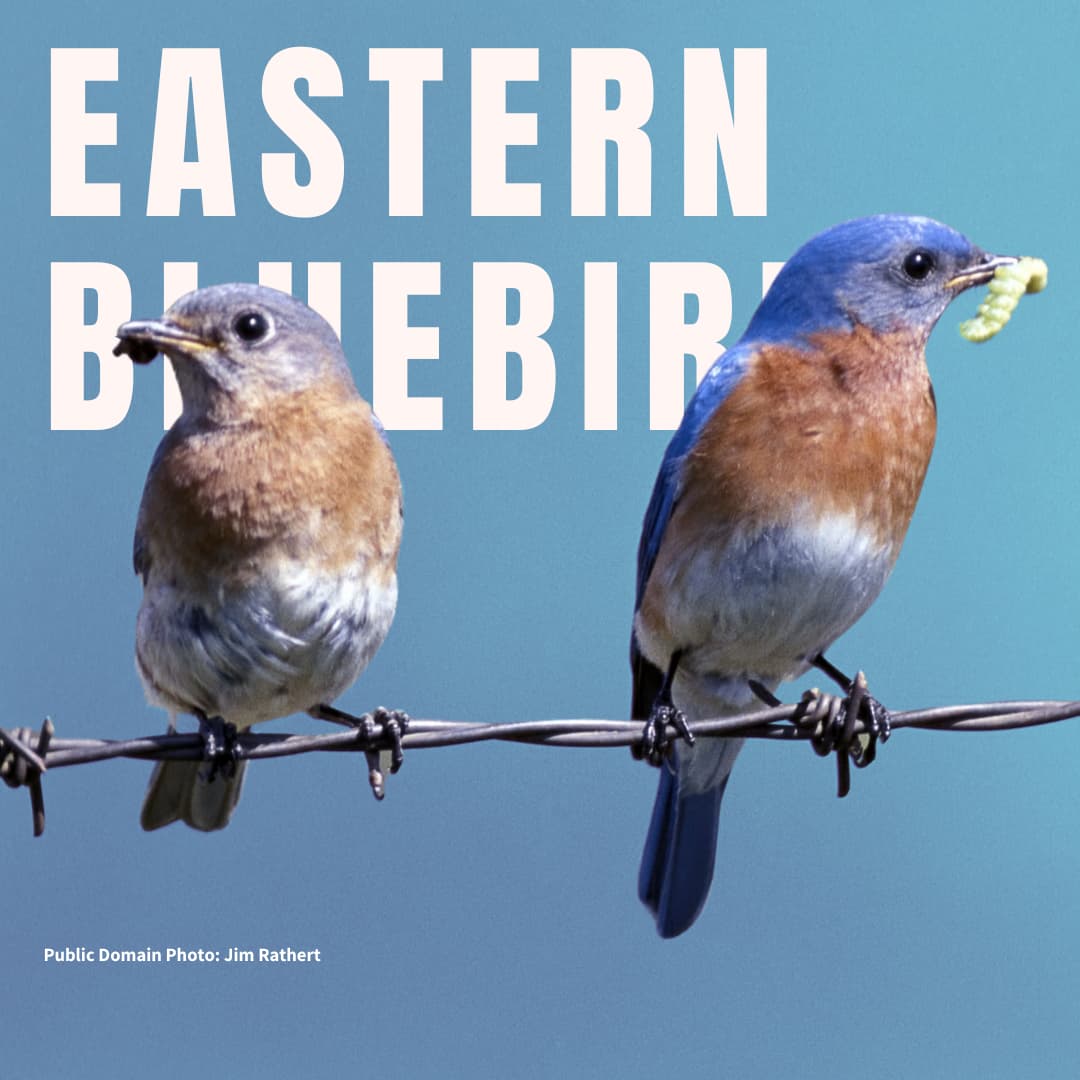
The Eastern Bluebird (Sialia sialis) once ranked among the most common birds in North America — then nearly vanished. Driven from its nest holes by two introduced European species, it collapsed by an estimated 90 percent over five decades. What brought it back was not a government program. It was ordinary people with lumber and a tape measure.
When the Blue Went Quiet
“It is sure to be a bright March morning when you first hear his note,” John Burroughs wrote in 1871, “and it is as if the milder influences up above had found a voice and let a word fall upon your ear, so tender is it and so prophetic, a hope tinged with a regret.” Quote ID: 7-003
By the middle of the twentieth century, fewer and fewer people were hearing that note at all.
Something had gone wrong in the hedgerows and orchards of eastern North America. The wooden fence posts had been replaced with metal ones. The old apple orchards had been cleared. Two uninvited European birds — one released by an insect-control scheme gone wrong, the other by a man with a fondness for Shakespeare — had claimed every available nest hole from Maine to Georgia. The Eastern Bluebird, which had required nothing more than a cavity and an open field, suddenly could find neither.
By the 1970s, ornithologists were calling it a vanishing species. A retired biochemist from Maryland decided that was unacceptable. What followed is one of the most instructive conservation stories of the twentieth century — not because of its scale, but because of who carried it out.
Conservation: Historical Baseline (Burroughs Era)
Before the decline, there was an abundance so ordinary it went unremarked.
When Burroughs walked the farmlands and hedgerows of the Hudson Valley in the 1870s, the Eastern Bluebird was simply part of the landscape, as expected as robins, as woven into the seasonal rhythm as the first crocus. “The bluebird enjoys the preeminence of being the first bit of color that cheers our northern landscape,” he wrote Quote ID: 7-010, describing a bird so reliably present that farmers treated its March arrival as an agricultural signal: in New York and New England, Burroughs recorded, the sap started up in the sugar maple the very day the bluebird arrived.
This was accidental abundance — populations sustained by habitats that existed for unrelated reasons. The great clearing of eastern forests by European settlers had created exactly what bluebirds need: open fields with scattered trees, wooden fence posts rotting into nest cavities, and apple orchards full of insect prey. Native Americans had long recognized the bird’s affinity for human-modified landscapes. Many tribes hung hollow gourds near their villages to attract bluebirds, which repaid the favor by consuming prodigious quantities of grasshoppers and caterpillars. The arrangement required no management, no monitoring, no intervention. The habitat was simply there.
By the late nineteenth century, bluebirds were believed to be at or near their peak abundance. MNopedia, drawing on mitochondrial DNA research, notes the species had been present in the upper Midwest for 8,000 to 10,000 years — a long tenure in landscapes shaped entirely by fire, beaver, and indigenous land management5. Burroughs documented them in every orchard and open wood, nesting in stumps and woodpecker holes throughout the countryside. The bird appeared as inevitable as spring itself.
That abundance would not survive the century.
Conservation: The Decline
Two dates mark the beginning of the end.
In 1851, a Brooklyn man named Nicholas Pike released eight pairs of House Sparrows near Green-Wood Cemetery in Brooklyn, New York10. The initial release failed. More birds were purchased and released the following year. Those took hold. Within a generation, House Sparrows had spread across the continent, filling every city, farm, and suburb with a bird that competed ferociously for exactly the cavities bluebirds required — and did not merely compete. House Sparrows enter occupied nest boxes and kill adult bluebirds trapped inside. They destroy eggs. They build nests over the bodies of birds they have killed10.
Then in 1890, a Shakespeare enthusiast released sixty European Starlings into Central Park in New York City, hoping to establish in America every bird mentioned in the works of the Bard10. The starling proved to be the only species that survived. It survived spectacularly. Larger and more aggressive than bluebirds, starlings claimed every sizeable tree cavity in the East.
The timing was catastrophic. Simultaneously, the agricultural landscape that had created bluebird habitat was being transformed. Wooden fence posts — which rotted into nest cavities over decades — were replaced by metal ones that offered nothing. Orchards were cleared. Pesticides decimated insect populations. In the South, fire ant colonization beginning in the 1930s added another pressure on ground-nesting and low-foraging birds. The cumulative effect was the elimination, cavity by cavity and field by field, of the conditions that had made bluebirds common.
By the 1960s, biologists described Eastern Bluebirds as facing extinction in parts of their range5. By the 1970s, the National Audubon Society placed them on its Blue List of species experiencing serious population losses11. The Minnesota Breeding Bird Atlas notes they appeared on that list in 1972 and again from 1978 to 198211. Several states added the species to their endangered or special-concern lists. Dr. Lawrence Zeleny — who would become the central figure in what followed — estimated the Eastern Bluebird population had declined by approximately 90 percent from its peak4.
The causes were not mysterious. The solution, however, required someone to actually attempt it.
Conservation: The Recovery
Lawrence Zeleny was born on April 30, 1904, in Minneapolis, Minnesota. His mother used to park his stroller next to a bird bath. He claimed one of his earliest memories was bluebirds playing in the water4.
He spent thirty years as a biochemist with the U.S. Department of Agriculture at the Beltsville Agricultural Research Center in Maryland, where he watched bluebirds decline through the 1950s as starlings arrived on the grounds. After his retirement in 1966, he asked his former director for permission to establish a bluebird trail on the center’s property. He placed 13 nest boxes. That trail would eventually span ten miles and more than sixty boxes4.
The key insight was mechanical. Zeleny understood that the 1.5-inch entrance hole — sized precisely to admit a bluebird but exclude the larger European Starling — could serve as a continent-wide filter. This is The Zeleny Specification: a single measurement, refined with input from other bluebirders, including Illinois biologist T. E. Musselman (who had pioneered the bluebird trail concept decades earlier), that solved the starling problem through geometry rather than confrontation3,4.
It did not solve the House Sparrow problem. House Sparrows are smaller than bluebirds and fit through the same hole. They remain the primary ongoing threat to bluebird nests and require active monitoring and trapping — a distinction that would shape how the entire movement operated10.
In 1976, Zeleny published The Bluebird: How You Can Help Its Fight for Survival through Indiana University Press. In June 1977, National Geographic published his article “Song of Hope for the Bluebirds” — the first piece in a major general-interest publication to describe the bluebird’s plight. Letters poured in4. When Zeleny and his colleague Delos “Chuck” Dupree traveled to New York to ask the National Audubon Society to lead a national preservation effort, they were declined — cordially3. They founded the North American Bluebird Society themselves. NABS was incorporated on March 20, 19783. In 1979, journalist Joan Rattner Heilman’s article in Parade magazine — then with a readership of fifteen million — sent another wave of interest crashing through American households.
As ornithologist Chandler S. Robbins of the NABS put it: there is not much the average person can do to help the Bald Eagle or the Whooping Crane, but an individual can help the bluebird.
That individual was everywhere. In Brooklyn Center, Minnesota, a retired machinist named Dick Peterson and his wife, Vi, had been designing and testing nest boxes since the 1970s. The Peterson box — steep-roofed, wedge-shaped, with an oval entrance measured to the sixteenth of an inch — was optimized for bluebird preference and predator resistance. The Petersons shared plans at no charge and trained thousands of people5. Children built Peterson boxes in 4H clubs, Boy Scouts, and shop class. Junior and senior high school students constructed them as Future Farmers of America projects. Civic groups established bluebird trails in parks, on golf courses, at cemeteries, along country roads5.
The Citizen Science Revolution that followed produced measurable results. In 1979, a spot check of Minnesota bluebirds found just eleven breeding pairs in the state5. Three years later, bird counters recorded 1,490 fledglings. By 1992, Minnesota fledged 14,800 bluebirds — more than any other state in the nation5. The New York Breeding Bird Atlas recorded a 70 percent increase in bluebird presence between its first survey (1980–85) and its second (2000–05)11.
The bluebird had not been saved by legislation or by professional wildlife managers. It had been saved by people with rulers.
Conservation: Current Status
Partners in Flight estimates the global Eastern Bluebird breeding population at 23 million birds1. The North American Breeding Bird Survey documents a population increase from 1966 through 20198. The species now rates a 7 out of 20 on the Continental Concern Score — low concern, a classification that would have been inconceivable in 19751.
This is Managed Abundance. The Eastern Bluebird of today is not the same kind of common as the Eastern Bluebird of Burroughs’s era. It is common because people make it common — building boxes, monitoring trails, managing House Sparrow pressure every season. The habitat that sustained bluebirds in 1871 no longer exists in the same form. The bird now depends on a distributed network of human infrastructure maintained by volunteers.
Two notes of caution. A peer-reviewed 2022 study in Ecosphere analyzing eBird data from 2009 to 2018 found Eastern Bluebird populations declining at 1.14 percent per year during that period9. This does not reverse the long-term BBS recovery trend, but it signals that the recovery is not self-sustaining. It requires continued human engagement. The boxes need to be built. The trails need to be walked. The House Sparrows need to be managed.
The philosophical question Zeleny’s experiment raised has not been fully answered: have we saved the Eastern Bluebird, or have we made ourselves responsible for it permanently? The answer may not matter. The bluebirds are here.
Identification: Eastern Bluebird
Quick ID Box
| Feature | Male | Female |
|---|---|---|
| Back & Head | Brilliant royal blue | Gray with blue tinge |
| Breast | Warm rufous-orange | Pale orange-buff |
| Belly | White | White |
| Bill | Short, thin, straight | Short, thin, straight |
| Size | 6–8 in / 27–34 g | Same |
| Wingspan | 10–13 in | 10–13 in |
| Posture | Upright, alert | Upright, alert |
Visual Description
The male Eastern Bluebird is built for immediate recognition: a deep, saturated blue across the back, crown, wings, and tail — the blue of a clear October sky rather than the muted blue-gray of many sparrows — paired with a rufous-orange throat and breast that wraps around the sides of the neck1. The belly is clean and white. No other common eastern bird combines blue above and rusty-orange below on such a compact, round-headed frame.
Females wear the same pattern in muted tones. The back is gray-brown with blue suffused through the wings and tail. The breast is a warm buff-orange, paler than the male’s. The key field mark distinguishing female Eastern from female Western Bluebird is the rusty wash extending up the sides of the neck — diagnostic for Eastern, absent in Western12.
Juveniles of both sexes wear the classic thrush look: spotted breast, dappled back, variable blue in wings and tail. They are spotted birds that will eventually become blue birds, and for a few weeks, they look like neither.
Field Marks
The Eastern Bluebird’s posture is as useful as its color. It sits upright and still on fence wires, utility lines, and nest box tops — an alert, vertical profile unlike the hunched silhouette of a sparrow2. When it drops to the ground after an insect, it does so with deliberate, fluttering wings and a slow final approach, then snaps back to its perch quickly. This Sit-and-Wait Strategy — hunt from a perch, descend to the ground, return — is the behavior pattern that makes bluebirds so rewarding to watch and so consistently findable in open habitat.
Vocalization: A Voice Like a Dropped Vowel
“The bird at first seems a mere wandering voice in the air,” Burroughs wrote: “one hears its call or carol on some bright March morning, but is uncertain of its source or direction; it falls like a drop of rain when no cloud is visible.” Quote ID: 1-012
The Eastern Bluebird’s song is soft, wavering, and multi-syllabic — a series of short, liquid phrases rendered variously as tru-al-ly or chiti WEEW wewidoo2. It carries well in open country but does not project with the authority of a robin or the insistence of a wren. You hear it and turn toward it; it is already somewhere else.
The call note — a soft, rising jeew or chir-wi — is the sound most often heard in the field as birds move between perches or communicate with mates2. In flight, bluebirds often call continuously, a gentle chatter that announces their presence before they come into view.
Behavior and Biology
Foraging Behavior
The Eastern Bluebird is an aerial-visual predator that hunts from perches. It scans from a fence wire or branch, spots movement in short grass below — a grasshopper, a cricket, a beetle — and drops with fluttering wings to take it1. It can detect prey from distances exceeding 60 feet2. In winter, when insects are scarce, it shifts to berries: mistletoe, sumac, dogwood, hackberry, holly, and juniper1.
The bluebird’s habitat requirement — open ground with scattered perches and low or sparse vegetation — is the spatial expression of this foraging strategy. Dense grass conceals prey. Dense forest removes the sight lines. The bird needs to see the ground and the ground needs to be findable.
Nesting Cycle
The Eastern Bluebird is a secondary cavity nester: it cannot excavate its own holes and depends entirely on cavities created by woodpeckers, natural decay, or humans1. Burroughs recorded this in 1871: “The bluebird usually builds its nest in a hole in a stump or stub, or in an old cavity excavated by a woodpecker, when such can be had.” Quote ID: 7-028
This dependency is the entire explanation for both the species’ collapse and its recovery.
The male selects a cavity site and performs an elaborate display — carrying nesting material in and out, fluttering his wings from the entrance, singing — to attract a female2. “He warbles and lifts his wings beseechingly,” Burroughs wrote, “but shows no anger or disposition to scold and complain like most birds. Indeed, this bird seems incapable of uttering a harsh note, or of doing a spiteful, ill-tempered thing.” Quote ID: 7-032
House Sparrows are aware of none of this. Once a female accepts the site, she builds the nest alone: a loose cup of fine grasses and pine needles, occasionally lined with animal hair or feathers1. She incubates 4–5 pale blue eggs for 13–16 days7. Nestlings leave the nest at 18–19 days7. A pair typically raises two broods per season, sometimes three7. Young from early broods may assist in feeding later nestlings — an unusual cooperative behavior documented in this species.
Social Structure
Eastern Bluebirds are territorial during the breeding season and social at other times. Males arrive before females in spring — the First-Mover Advantage of early migration — and claim territories of several acres centered on suitable nest cavities1. Outside of breeding season, they join loose flocks of a dozen to over a hundred birds, moving through the landscape together in search of fruiting trees and winter insect sources2.
Pair bonds are typically stable and often persist across multiple seasons, though genetic studies reveal that roughly one in four or five eggs involves a bird from outside the mated pair8. The Eastern Bluebird’s reputation as the emblem of domestic contentment has always been slightly complicated by the data.
Similar Species: How to Tell Them Apart
| Species | Key Difference (Male) | Key Difference (Female) | Range |
|---|---|---|---|
| Eastern Bluebird | Blue back, rufous-orange throat AND breast, white belly | Gray-brown back, rusty neck wash, white belly | East of Rocky Mountains |
| Western Bluebird (Sialia mexicana) | Blue throat (not orange), chestnut extends to scapulars, gray-blue belly | Gray throat (no contrast with face), gray belly | West of Rocky Mountains |
| Mountain Bluebird (Sialia currucoides) | Entirely sky-blue — no orange or chestnut anywhere | Gray-brown with blue tinge only in wings/tail; no rufous | Western mountains; overlaps Eastern only in northern Great Plains |
| Indigo Bunting (Passerina cyanea) | Deep blue but uniform, no orange; thick finch bill for crushing seeds | Plain brown, no blue at all | Overlaps Eastern range substantially |
The quickest separator for the three bluebirds: Eastern males have an orange throat; Western males have a blue throat; Mountain males have no orange anywhere. For females: Eastern has a rusty neck wash; Western has a gray throat with no contrast; Mountain shows almost no rufous at all12.
Indigo Buntings confuse beginners despite being unrelated. The bill is the tell: a thick, seed-crushing finch bill versus the bluebird’s slim, insect-catching bill. Also, Indigo Bunting males are uniformly deep blue with no orange whatsoever.
FAQ: Common Questions About the Eastern Bluebird
1. How do I tell a male Eastern Bluebird from a female?
Males are unmistakable in good light: brilliant royal blue above, warm rufous-orange on the throat and breast, white belly1. Females are paler and grayer overall, but retain blue tones in the wings and tail and show a warm buff-orange wash on the breast. A rusty wash extending up the sides of the neck is diagnostic for female Easterns and separates them from female Western Bluebirds12.
2. How do I attract Eastern Bluebirds to my yard — what do they eat?
Bluebirds eat insects for most of the year — grasshoppers, crickets, beetles, caterpillars, and spiders — and switch to berries in fall and winter1. The most reliable attractant is a properly placed nest box in open habitat. If you want to offer food directly, live or dried mealworms are highly effective and will often draw bluebirds to a feeder within a season. Avoid general seed mixes, which attract House Sparrows.
3. What size entrance hole does a bluebird nest box need, and why does it matter?
The standard entrance hole is 1.5 inches in diameter. This measurement admits Eastern Bluebirds but excludes European Starlings, which are larger4. This single specification — The Zeleny Specification — was the mechanical key to the species’ recovery. It does not exclude House Sparrows, which are smaller than bluebirds. Sparrow management requires active weekly monitoring and, where necessary, humane trapping10.
4. Are Eastern Bluebirds year-round residents or do they migrate?
Partially both. Populations in the northern part of the range — Canada and the northern U.S. — are migratory, wintering in the southeastern United States or Mexico, sometimes flying up to 2,000 miles2. Southern populations may remain on or near their breeding territories year-round. In winter, even resident birds shift into loose flocks that roam widely in search of fruiting trees.
5. How many broods do Eastern Bluebirds raise per year?
Typically two broods per season, sometimes three7. This productivity is part of why the species responded so quickly to the nest box movement — given adequate cavities, bluebirds maximize nesting attempts. Removing the old nest after fledging encourages the pair to attempt another brood in the same box within the same season.
6. Why do House Sparrows and European Starlings threaten bluebirds, and what can I do about it?
Starlings and House Sparrows both compete aggressively for nest cavities. The 1.5-inch entrance hole solves the starling problem — starlings cannot fit through it4. House Sparrows can and do enter bluebird boxes, where they will kill adult bluebirds, destroy eggs, and build nests over the carnage10. The solution is weekly monitoring during breeding season and active sparrow management. House Sparrows are not protected under the Migratory Bird Treaty Act and may be legally removed.
7. Are Eastern Bluebirds endangered today?
No. Partners in Flight estimates the global breeding population at 23 million birds, and the species rates a 7 out of 20 on the Continental Concern Score — low concern1. However, a peer-reviewed study found populations declining at 1.14 percent per year between 2009 and 20189. The recovery is real but not self-sustaining. It depends on continued nest box infrastructure and active sparrow management.
8. What’s the difference between an Eastern Bluebird and a Western or Mountain Bluebird?
Eastern males have an orange throat; Western males have a blue throat with chestnut restricted to the back; Mountain males are uniformly sky-blue with no orange anywhere12. Range is usually the decisive factor: Western and Mountain Bluebirds live west of the Rocky Mountains, with only limited overlap with Eastern in the northern Great Plains. Female identification is trickier; the rusty neck wash on female Easterns is the most reliable field mark.
Key Takeaways
- The Zeleny Specification: A 1.5-inch entrance hole admits Eastern Bluebirds while excluding European Starlings — this single measurement became the mechanical engine of a continental recovery4
- 90% Collapse, Then Recovery: The Eastern Bluebird declined an estimated 90 percent from its peak before the nest box movement reversed the trend; the North American Breeding Bird Survey documents population increases from 1966 through 20191,8
- Managed Abundance: The species now numbers an estimated 23 million globally, but this abundance is maintained — not wild; continued nest box infrastructure and House Sparrow management are required for the population to hold1
- The Peterson Proof: In Minnesota, 11 breeding pairs in 1979 became 1,490 fledglings in 1982 and 14,800 fledglings in 1992 — the most of any state — through citizen-led nest box programs5
- Burroughs’s Baseline: In 1871, the Eastern Bluebird was so common that Burroughs called it “the first bit of color that cheers our northern landscape” Quote ID: 7-010; its near-disappearance a century later and return since then bracket one of conservation’s most instructive arcs
- Ongoing Vigilance: A 2022 peer-reviewed study found populations declining at 1.14 percent per year between 2009 and 2018 — the recovery is real, but it is not finished9
- Action: Install a 1.5-inch nest box 5 feet high on a smooth metal pole with a predator baffle, place it in open habitat at least 100 yards from other boxes, and monitor weekly during breeding season — this is how the bluebird came back, and it is how it stays
Bibliography
Modern Scientific Sources
[1] Cornell Lab of Ornithology. (2024). Eastern Bluebird Life History. All About Birds. https://www.allaboutbirds.org/guide/Eastern_Bluebird/lifehistory
[2] Cornell Lab of Ornithology. (2024). Eastern Bluebird Identification. All About Birds. https://www.allaboutbirds.org/guide/Eastern_Bluebird/id
[3] North American Bluebird Society. (2024). NABS History. https://www.nabluebirdsociety.org/nabs-history/
[4] Sialis.org. (2024). Bluebirder Lawrence Zeleny. https://www.sialis.org/zeleny/
[5] Minnesota Historical Society MNopedia. (2025). Peterson Bluebird Nest Box. https://www.mnhs.org/mnopedia/search/index/thing/peterson-bluebird-nest-box
[6] MinnPost / MNopedia. (2025). How the Peterson Nest Box Saved the Eastern Bluebird. https://www.minnpost.com/mnopedia/2025/10/how-the-peterson-nest-box-saved-the-eastern-bluebird/
[7] National Audubon Society. (2024). Eastern Bluebird Field Guide. Audubon. https://www.audubon.org/field-guide/bird/eastern-bluebird
[8] Sauer, J. R., D. K. Niven, J. E. Hines, D. J. Ziolkowski Jr., K. L. Pardieck, J. E. Fallon, and W. A. Link. (2019). The North American Breeding Bird Survey, Analysis Results 1966–2019. U.S. Geological Survey. https://www.usgs.gov/tools/north-american-breeding-bird-survey-results-and-analysis
[9] Sonnleitner, R., et al. (2022). Rapid shifts in migration routes and breeding latitude in North American bluebirds. Ecosphere, 13(12). https://esajournals.onlinelibrary.wiley.com/doi/10.1002/ecs2.4316
[10] Florida Bluebird Society. (2024). History. https://floridabluebirdsociety.org/history/
[11] Minnesota Breeding Bird Atlas. (2020). Eastern Bluebird Species Account. https://mnbirdatlas.org/species/eastern-bluebird/
[12] Kaufman, K. (2024). How to Identify Bluebirds. BirdWatching Magazine. https://www.birdwatchingdaily.com/birds/kenn-kaufmans-id-tips/identify-bluebirds/
Historical Sources
Burroughs, J. (1871). Wake-Robin. New York: Hurd and Houghton.
Burroughs, J. (1875). “The Bluebird” in Winter Sunshine. New York: Hurd and Houghton.
Burroughs, J. (1895). Introduction to Wake-Robin (Revised Edition). Boston: Houghton Mifflin.
Zeleny, L. (1976). The Bluebird: How You Can Help Its Fight for Survival. Bloomington: Indiana University Press.
Historical Sources
Return of the Birds: A John Burroughs Wake-Robin Revival (2022) 44from26. (Peter Meddick, editor, 2022), audiobook on Audible.
Quote 7-003: Spring arrival — a voice tender and prophetic on a bright March morning. Source
Quote 7-010: The bluebird as the first bit of color that cheers the northern landscape. Source
Quote 1-012: The bird as a wandering voice in the air on a March morning. Source
Quote 7-028: The bluebird’s nest in a stump, stub, or old woodpecker cavity. Source
Quote 7-032: The male’s beseeching warble — incapable of a harsh note or spiteful act. Source
Carson, Rachel. (1962). Silent Spring. Houghton Mifflin.
Zeleny, Lawrence. (1976). The Bluebird: How You Can Help Its Fight for Survival. Indiana University Press.