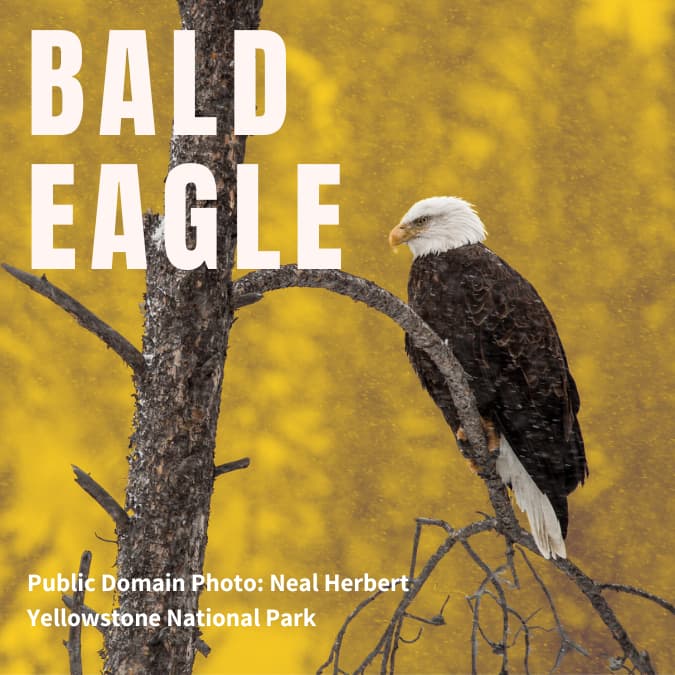
The Bald Eagle (Haliaeetus leucocephalus)became America’s national symbol in 1782, when roughly 100,000 nesting pairs existed across the continent. By 1963, DDT had reduced that to 417. A telephone lineman, a wildlife biologist, and the world’s first eagle hacking tower reversed the collapse. Today 316,700 eagles soar the lower 48—but a new poison is already in their bones.
The Last Eagle in New York
In 1965, Tom Rauber was eating lunch in his truck near Hemlock Lake in Livingston County, New York. He worked for Rochester Telephone Corporation—a lineman, not a naturalist by training. But he had sharp eyes.
There, in an 80-foot shagbark hickory tree, were two bald eagles. White heads, brown bodies. The last nesting pair in all of New York State6.
Rauber didn’t call anyone. He watched. He came back. He kept a journal. Over the next 27 years, he made nearly 1,400 visits to that tree and logged more than 52,000 miles traveling to study eagle behavior in Alaska, British Columbia, Montana, Wyoming, and Florida—all while holding down his job with the phone company6.
“But what has interested me most in Ornithology is the pursuit, the chase, the discovery; that part of it which is akin to hunting, fishing, and wild sports, and which I could carry with me in my eye and ear wherever I went,” Quote ID: P-004 John Burroughs wrote. Rauber was not a Burroughs reader. He was simply a man who could not look away from something disappearing.
Burroughs aimed to present nature not as catalog but as living drama: “I have tried to present a live bird—a bird in the woods or the fields—with the atmosphere and associations of the place, and not merely a stuffed and labeled specimen” Quote ID: P-006. The Bald Eagle’s story is exactly that: a living drama, with protagonists, near-tragedy, and an unresolved final act.
What follows is the account of how one pair became 426 nesting territories in New York alone—and why the story isn’t finished.
Conservation: Historical Baseline (Burroughs Era)
When the Second Continental Congress adopted the Bald Eagle as the national emblem on June 20, 1782, the choice reflected biological reality: the bird was everywhere. Estimates suggest roughly 100,000 nesting pairs across the continent at that moment3. Along the Hudson River, the Chesapeake Bay, the Great Lakes, the Pacific Northwest—eagles were fixtures of the American waterway, as unremarkable as the rivers themselves.
John Burroughs, writing from his Hudson Valley home at West Park, New York, observed a landscape in the 1870s where eagles still nested along the Hudson and soared above the river he walked daily. New York alone supported more than 70 nesting pairs in the 1800s and early 1900s, and served as wintering grounds for several hundred additional birds7. This was Accidental Abundance: a wildlife population existing at its natural carrying capacity, requiring nothing from humans except to be left alone.
“Yet the coming and going of the birds is more or less a mystery and a surprise,” Burroughs observed. “We go out in the morning, and no thrush or vireo is to be heard; we go out again, and every tree and grove is musical; yet again, and all is silent.” Quote ID: 1-008 He wrote this about forest songbirds, but the observation captures something precise about Bald Eagles: their presence, at historic abundance, was not dramatic. Eagles were simply part of the American waterway until the silence came.
For Native American nations across the continent—among them the Lakota, Ojibwe, and Cherokee—the eagle carried a spiritual status that predated the republic by millennia. Eagle feathers marked the highest honors; the bird’s flight connected the earthly to the sacred. This dual identity, national symbol and sacred creature, would lend the species’ near-extinction an almost symbolic weight when the crisis arrived.
By the early twentieth century, the first wave of decline had already begun: habitat loss, legal and illegal hunting, and persecution by farmers who blamed eagles for predating livestock had worn steadily at the population3. But the worst was still coming, and it would arrive invisibly.
Conservation: The Decline
DDT arrived in American agriculture in the mid-1940s and seemed miraculous—cheap, effective, and deadly to the insects destroying crops and carrying disease. Nobody paid much attention to where it went afterward.
It went into the water. DDT washed off fields into streams, settled into sediment, was absorbed by aquatic invertebrates, concentrated in fish, and biomagnified at each step up the food chain. Bald Eagles, Osprey, and Peregrine Falcons—apex predators feeding primarily on fish and other vertebrates—absorbed DDT at levels that disrupted calcium metabolism in females. The result was eggshells so thin they broke under the gentle weight of a sitting parent3.
The Hemlock Lake pair followed this pattern faithfully across more than a decade. Year after year through the late 1950s and 1960s, they built their nest—a monument to persistence, constructed from a half-ton of sticks and twigs, measuring 6 feet across and 7 feet deep6—laid eggs, incubated them, and watched them fail. The shells simply collapsed.
In 1963, ornithologists surveying the lower 48 states found only 417 nesting pairs of Bald Eagles remaining in the entire contiguous United States3. From an estimated 100,000 at the republic’s founding to fewer than the population of a small town. In 1967, the Secretary of the Interior listed the species under the Endangered Species Preservation Act. By 1972, when DDT was finally banned in the United States—driven in no small part by Rachel Carson’s 1962 Silent Spring, which named the mechanism and named the culprit—only one breeding pair remained in all of New York State, and that pair had failed to hatch an egg for years5.
That same year, 1972, Tom Rauber was granted federal permission to use his lineman’s climbing gear to ascend to the Hemlock Lake nest and retrieve an addled egg. He sent it to the Patuxent Research Center in Maryland. The analysis came back: DDT confirmed6. He already knew. But now there was documentation.
Rachel Carson had given the problem a name and a mechanism. Rauber had given it a face: two eagles in a shagbark hickory tree, year after year, sitting on eggs that would never hatch.
Conservation: The Recovery
In 1974, a letter arrived at Tom Rauber’s house in Dansville. Gene McCaffrey, chief of wildlife for the New York State Department of Environmental Conservation, wrote to say the agency intended to initiate a bald eagle recovery program—and asked if Tom Rauber would help set it up7.
Rauber said yes, then stepped back. With DEC’s resources and personnel, a state program could do what an amateur with a birding journal never could alone. His first contribution was to introduce the agency’s new wildlife technician, a young man named Mike Allen who had never seen a bald eagle in his life, to the Hemlock Lake nest. Allen later described the moment he watched the last adult female eagle fly over a hill toward that nest: “I was hooked. That’s all it took, and it’s been like that ever since.”1.
Working with the U.S. Fish and Wildlife Service and Dr. Tom Cade of Cornell University’s Laboratory of Ornithology, DEC biologist Peter Nye devised the Hacking Protocol for bald eagles. Young birds, obtained primarily from Alaska, where populations had never collapsed, were placed on elevated platforms inside wire cages several weeks before they were ready to fledge. Human caretakers worked from blinds, feeding birds through trap doors, never allowing the eagles to associate food or shelter with a human presence. When the birds were twelve weeks old and their feathers fully developed, the cage door opened4.
The first hacking tower at Montezuma National Wildlife Refuge—a former bald eagle nesting area found free of DDT contamination—was erected in 1976. It was the first program of its kind on the North American continent6. At least two attendants monitored the site around the clock, seven days a week. Nye later described the effort as “very much an experiment, very much an iffy situation”1. Nobody had hacked bald eagles before.
Burroughs understood the precariousness of the equation: “It usually happens, when the male of any species is killed during the breeding season, that the female soon procures another mate” Quote ID: 4-049. He could have been writing about Hemlock Lake in 1980, when the resident male—New York’s last native-born eagle—was found shot dead near the nest. The female mated with a hacked bird. The nest survived. A single act of illegal shooting nearly ended everything; the resilience of the female and the availability of a replacement from the program preserved it.
That same year, 1980, the program produced its first proof of concept. Two-banded birds were discovered nesting near Watertown, in Jefferson County, 84 miles north of Montezuma. Both were birds from the very first cohort released in 1976. They were Henry and Agnes, the first eaglets the program had ever placed in the tower, now a nesting pair with a surviving chick1. Nye’s reaction: “We were just ecstatic about that. This is phenomenal. They actually set up a nest and had young. That was like a huge shot in the arm. We said, ‘This can work. This is no longer an experiment. This can work.’”1
Over the next nine years, three hacking towers released 198 nestling eagles at four locations across New York State<sup>4</sup>. The model spread to more than 14 states across the Northeast, with the region ultimately releasing approximately 1,200 eagles total6. By 1989, the program had achieved its goal: 10 established breeding pairs in New York. It put itself out of business—the benchmark for a successful conservation program.
Tom Rauber, Mike Allen, and Peter Nye received DEC commendations in 2013. Rauber published his account as Bald Eagles Soar Again: One Man’s Quest to Prevent the Extinction of the Bald Eagle in the U.S. in 2014. Rauber died on December 27, 2017, at age 93. Allen died two months earlier, at 65, after a long illness. The mid-winter eagle survey at Montezuma in January 2018—the site where it all started—counted 81 eagles. A record.
Conservation: Current Status
The Bald Eagle was officially delisted from the Endangered Species Act on June 28, 2007, when more than 10,000 nesting pairs existed in the lower 48 states3. The ceremony was held at the Jefferson Memorial. A fitting backdrop.
The recovery has continued. A 2021 USFWS population report, augmented for the first time by eBird citizen-science data from more than 180,000 volunteer observers, estimated 316,708 individuals and 71,467 nesting pairs in the lower 48 states—more than four times the 2009 figure10. New York reached 426 active breeding pairs in 2017, fledging 209 young5. The Chesapeake Bay region now hosts the largest concentration of Bald Eagles in the lower 48 states outside Alaska, with Maryland alone supporting more than 1,400 breeding pairs—grown from 44 pairs in 197711. Blackwater National Wildlife Refuge in Dorchester County, Maryland, is the single highest-density breeding site on the East Coast north of Florida.
The Citizen Science Vigil continues. Volunteer nest monitoring networks—among them the Maryland Bird Conservation Partnership—now recruit observers to visit known nest sites three times each breeding season, tracking adult activity, chick presence, and fledging success11. Rauber did this alone, for 27 years, with a truck and a journal. It now scales across states.
But a study published in Science in February 2022 named a new threat with the same precision that Rauber brought to his egg analysis in 1972. Vince Slabe and Todd Katzner, leading a team spanning the USGS, Conservation Science Global, and U.S. Fish and Wildlife Service, evaluated lead exposure in 1,210 bald and golden eagles from 38 states across the continent. They found that 47% of bald eagles showed chronic lead poisoning, measured in bone—evidence of repeated, cumulative exposure across lifetimes8. The primary mechanism: fragments of lead hunting ammunition that spread into gut piles and carcasses when animals are field-dressed. Eagles, as scavengers, consume these fragments when food is scarce, particularly in winter. Demographic modeling in the study concluded that this level of poisoning suppresses bald eagle population growth by 3.8% annually (95% confidence interval: 2.5–5.4%)9.
The population is still growing. But more slowly than it should—and the exposure is invisible, cumulative, and continent-wide. California is currently the only state with a comprehensive lead ammunition ban. New York is piloting a hunter rebate program for non-lead alternatives through a Cornell/DEC partnership. DDT, at least, had no politically organized constituency. Lead ammunition does. The next chapter of this story is not yet written.
Identification: Bald Eagle
Quick ID Box
| Feature | Adult | Immature (Years 1–4) |
|---|---|---|
| Head | Brilliant white | Dark brown, mottled |
| Body/Wings | Dark chocolate-brown | Brown, variably mottled with white |
| Tail | White | Dark brown, gradually whitening |
| Bill | Large, bright yellow, hooked | Darkening to yellow with age |
| Eyes | Pale yellow-white | Dark brown |
| Wing profile in flight | Flat “flying board” — wings held level | Same flat profile at all ages |
| Size | 31 in. body; 5.9–7.5 ft wingspan | Same |
| Weight | Female avg. ~12 lbs; male avg. ~9 lbs | Same sex ratio |
Full adult plumage—white head and tail—is not acquired until approximately age five2.
Visual Description and Field Marks
The Bald Eagle is one of the largest birds in North America: heavier-bodied than a Turkey Vulture or Red-tailed Hawk, with a wingspan slightly greater than a Great Blue Heron’s2. The decisive structural field mark is the head. In flight, it juts visibly forward of the wing plane, projecting roughly as far ahead as the tail trails behind. No other large raptor in the East shows this protruding, forward-heavy silhouette.
Wings are held flat—the “flying board” profile that distinguishes Bald Eagles from Turkey Vultures (which rock and tilt in a V) and Golden Eagles (a shallow V dihedral) at any distance and any light condition2.
Females average approximately 25% larger than males—about 12 pounds versus 9—one of the more pronounced examples of reverse sexual dimorphism among raptors2. When a mated pair perches side by side, the difference is obvious. Northern birds tend to be larger than southern ones, following Bergmann’s Rule.
One vocabulary note worth making: Bald Eagles are not bald. The name derives from Old English balde, meaning white or white-marked—a description of the adult’s brilliant white head feathers. The bird was named for exactly what it looked like. Immature birds, which carry dark mottled heads for their first four or five years, have made the name seem paradoxical to observers for centuries. It isn’t.
Vocalization: The Bird Hollywood Got Wrong
Every film, every TV drama, every patriotic commercial: an eagle soars overhead and a piercing, descending screech fills the soundtrack. That sound belongs to a Red-tailed Hawk.
The Bald Eagle’s actual call is a rapid, high-pitched cackle—a series of weak, gull-like chittering notes. Ornithologist William Brewster, writing in 1925, described it as “weak in volume and trivial in expression… a snickering laugh expressive of imbecile derision, rather than anything else,” rendering it phonetically as “Ki-ki-ki-ki-ki-ki-ker”13. Anna Morris, director of wildlife ambassador programs at the Vermont Institute of Natural Science, offered a more accessible description: the real call sounds “kind of like a seagull with laryngitis”12.
Hollywood sound editors, seeking a vocalization worthy of the national symbol’s visual grandeur, began substituting the Red-tailed Hawk’s dramatic, raspy descending scream in the early film era. The practice became standard and is, in Morris’s word, “rampant”12 —present in the Colbert Report opening sequence, in Beyoncé’s “Desert Eagle,” and in virtually every nature documentary featuring a soaring eagle. Most Americans have never heard the actual Sonic Signature of the national bird.
The two primary vocalizations are the Chatter Call (also called the Keek): three to four introductory notes followed by a rapid descending sequence, phonetically “kwit kwit kwit kwit kee-kee-kee-kee-ker,” pitched at roughly 3–5 kHz, with a gull-like quality13. And the Peal Call: a higher-pitched, prolonged cry often repeated three to five times, used in territorial and nest-site contexts.
Hear the authentic calls—no Red-tailed Hawks—at the Cornell Lab of Ornithology’s All About Birds Sounds page: https://www.allaboutbirds.org/guide/Bald_Eagle/sounds. The surprise is reliable.
Behavior and Biology
Foraging: The Pirate and the Predator
Fish are the dietary core—salmon, herring, shad, catfish—but the Bald Eagle is an opportunist of the first order<sup>1</sup>. It hunts from perches and from flight, wading for shallow fish or swooping low to snatch them from the surface. It also pirates: a Bald Eagle will harry an Osprey with sustained aerial harassment until the smaller bird drops its catch, then snatch the fish mid-air. Benjamin Franklin, in an 1784 letter objecting to the eagle’s selection as national symbol, called it “a Bird of bad moral Character” who “does not get his Living honestly”1. Franklin lost the argument.
In winter, when live prey is scarce, eagles rely heavily on scavenging carrion—including gut piles left by hunters after field-dressing game. This scavenging behavior, ecologically essential to the species, is precisely what exposes eagles to lead ammunition fragments8.
Nesting: Architecture as Commitment
Bald Eagles build the largest nests of any North American bird, and they build for decades. A typical active nest runs 5 to 6 feet wide and 2 to 4 feet deep; pairs add sticks, grass, and soft material each year, and the structure grows accordingly<sup>1</sup>. Burroughs documented the scale from historical record: “The bald eagle, also, builds on high rocks, according to Audubon, though Wilson describes the nest of one which he saw near Great Egg Harbor… It was a vast pile of sticks, sods, sedge, grass, reeds, etc., five or six feet high by four broad…” Quote ID: 4-145. Wilson was writing in the early nineteenth century. The scale has not changed.
The North American record nest, in St. Petersburg, Florida, measured 9.5 feet wide and 20 feet deep1. A nest in Vermilion, Ohio reached a documented weight of nearly two metric tons and was used for 34 consecutive years before the supporting tree blew down. These are nests as biographical documents—records of continuous occupation across decades of a pair’s life.
In New York, courtship and nest building begin as early as January. Eggs are laid February through April, incubation lasts approximately 35 days (shared by both parents), and young make their first flights 10–12 weeks after hatching5. Fledglings typically remain near the nest territory for weeks, continuing to receive food from parents before dispersing into the nomadic years of immaturity.
The Death Spiral
Among the most dramatic behaviors in North American ornithology, Bald Eagle courtship includes the talon-locking aerial display. Two birds fly high, lock talons together, and cartwheel toward the earth in a spinning descent—releasing just before impact1. The display, sometimes called the “death spiral,” functions in pair bonding and territory establishment. Eagles that witness it tend to be unreliable narrators: the experience produces descriptions like “I watched them for twenty minutes and I still don’t understand how they survive it.” They do, reliably. The drop is controlled. The release is precise. The whole performance has the quality of a calculated risk executed by partners who trust each other exactly that much.
Similar Species: How to Tell Them Apart
| Species | Key Difference from Bald Eagle | Habitat Preference | Range Overlap |
|---|---|---|---|
| Golden Eagle (Aquila chrysaetos) | Dark wingpits (axillaries) in ALL plumages—Bald Eagle always shows white or whitish wingpits; smaller proportional head; golden/tawny nape hackles visible in good light; wings in shallow V vs. Bald Eagle’s flat board | Open uplands, cliffs, mountains; avoids aquatic habitat | Uncommon in eastern U.S.; regular at Hawk Mountain (PA) and Cape May (NJ) in fall migration |
| Osprey (Pandion haliaetus) | Smaller (23 in. body length vs. 31 in.); bent-wrist “gull-like” wing crook vs. flat board; white underside with bold dark wrist patches; dark eye stripe; dives feet-first into water for fish | Lakes, rivers, coasts; always near water | Widespread overlap throughout North America; most commonly confused with Bald Eagle by beginning birders |
The single most reliable field mark for separating a juvenile Bald Eagle from a juvenile Golden Eagle: the wingpit (axillary) color. Bald Eagles always show white or whitish there; Golden Eagles show dark in all plumages and at all ages. This mark is visible at distances where head shape and nape color are ambiguous.
FAQ: Common Questions About the Bald Eagle
1. How do I tell a juvenile Bald Eagle from a Golden Eagle—they both look brown?
Look at the wingpits. Juvenile Bald Eagles always show white or whitish axillaries visible from below in flight; Golden Eagles show dark wingpits in every plumage. Also note head size: the Bald Eagle’s head is large and protrudes visibly forward of the wings, while the Golden Eagle’s head is smaller and proportional. Wing profile helps too—Bald Eagles hold wings flat like a board; Golden Eagles hold them in a slight V.
2. Why don’t Bald Eagles look “bald”—where does the name come from?
It has nothing to do with hairlessness. The name derives from Old English balde, meaning white or white-marked—a description of the adult’s brilliant white head feathers. The bird was named for exactly what it looked like at maturity. Immature birds carry dark mottled plumage for their first four or five years, which is why the name seems confusing until you know the etymology.
3. Are Bald Eagles recovered, or are they still endangered?
They were officially delisted from the Endangered Species Act in 20073, and the 2021 USFWS estimate of 316,708 individuals in the lower 48 confirms continued strong growth10. However, a 2022 Science study found 47% show chronic lead poisoning—suppressing annual population growth by an estimated 3.8%8. Recovered from DDT-era collapse: yes. Free of significant ongoing threat: not yet.
4. What do Bald Eagles actually eat—is it mostly fish?
Fish are the dietary core—salmon, herring, shad, and catfish are common prey—but eagles are broadly opportunistic1. They take birds, mammals including rabbits and muskrats, reptiles, amphibians, and substantial quantities of carrion. They also pirate food aggressively from Ospreys and other raptors. In winter, when live prey is harder to find, scavenging increases—and it’s this winter scavenging that drives exposure to lead ammunition fragments in hunting gut piles.
5. How big are Bald Eagle nests, and do they reuse them year after year?
Yes—pairs return annually and add material, and nests grow across decades. A typical nest is 5 to 6 feet wide and 2 to 4 feet deep1. The North American record, in St. Petersburg, Florida, measured 9.5 feet wide and 20 feet deep. A nest in Vermilion, Ohio weighed nearly two metric tons and was continuously occupied for 34 years before the tree fell.
6. What is the “death spiral” courtship display?
During pair bonding and territory establishment, two eagles fly high, lock talons together, and cartwheel toward the ground in a controlled spinning descent—releasing just before impact1. It functions as both a pair-bonding ritual and, likely, a mutual test of coordination and trust. Eagles release well before hitting the ground. The display can involve multiple cartwheeling sequences. Observers who witness it describe it consistently as one of the most arresting sights in North American birding.
7. Are Bald Eagles still threatened by lead poisoning from hunting ammunition?
Yes, significantly. The Slabe et al. 2022 Science study sampled 1,210 eagles from 38 states and found 47% showed chronic lead poisoning in bone tissue8. Lead fragments from rifle rounds spread far beyond the wound channel into gut piles that eagles and other scavengers consume. Population growth is being suppressed at an estimated 3.8% annually. California has banned lead ammunition statewide; New York is piloting a non-lead hunter rebate program. Transitioning to copper or other non-lead ammunition is the most direct solution available to individual hunters.
8. How can I find Bald Eagles near me, and when is best?
Head for water—lakes, rivers, reservoirs, and coasts. Eagles concentrate and become most visible in winter, when northern birds push south to find open water and food2. The Chesapeake Bay region holds the highest concentration in the lower 48 outside Alaska; Blackwater National Wildlife Refuge in Dorchester County, Maryland, is the single best viewing site on the East Coast11. In New York, Montezuma NWR—where the hacking program launched in 1976—reliably hosts eagles year-round, and the annual mid-winter eagle count there regularly exceeds 44 birds.
Key Takeaways
- From 100,000 to 417 to 316,708: America’s national symbol collapsed to 417 nesting pairs by 1963 under DDT, then recovered to an estimated 316,708 individuals by 2021—the most dramatic large-raptor recovery in North American history10
- The Hemlock Protocol: Tom Rauber, a telephone lineman from Dansville, NY, made 1,400 visits over 27 years to document the state’s last eagle pair, drafted the first recovery proposal with ornithologist Dean Amadon, and handed the work to DEC in 1974—proof that individual commitment can seed institutional action6
- The world’s first eagle hacking tower: Montezuma NWR, 1976—Peter Nye and Dr. Tom Cade of Cornell Lab developed a technique never previously used for bald eagles; the model spread to 14+ states and the Northeast released approximately 1,200 eagles total, including Henry and Agnes, who flew 84 miles to nest in Jefferson County in 19804
- The new invisible poison: 47% of bald eagles show chronic lead poisoning (Slabe et al., Science, 2022), suppressing annual population growth by 3.8%—the same kind of incremental, cumulative threat that DDT represented a generation ago8
- The bird Hollywood got wrong: The “eagle screech” in virtually every film and TV show is the call of a Red-tailed Hawk; the real Bald Eagle call is a weak, gull-like cackle that one wildlife educator described as “a seagull with laryngitis”12
- Burroughs’ baseline: When Burroughs observed eagles along the Hudson River in the 1870s, New York hosted more than 70 nesting pairs7 —a number that collapsed to one pair by 1972, and recovered to 426 by 2017
- Action: If you hunt or know hunters, transitioning to non-lead ammunition is the single most direct individual response to the eagle’s current and ongoing threat—the biology of the solution is simpler than the politics
Bibliography
Modern Scientific Sources
[1] Cornell Lab of Ornithology. (2024). Bald Eagle Life History. All About Birds. https://www.allaboutbirds.org/guide/Bald_Eagle/lifehistory
[2] Cornell Lab of Ornithology. (2024). Bald Eagle Identification. All About Birds. https://www.allaboutbirds.org/guide/Bald_Eagle/id
[3] U.S. Fish and Wildlife Service. (2024). Bald Eagle (Haliaeetus leucocephalus). Species Profile. https://www.fws.gov/species/bald-eagle-haliaeetus-leucocephalus
[4] New York State Department of Environmental Conservation. (2023). Bald Eagle: New York State Program. https://dec.ny.gov/nature/animals-fish-plants/bald-eagle
[5] New York Natural Heritage Program. (2023). Bald Eagle Conservation Guide (Haliaeetus leucocephalus). NYNHP/SUNY-ESF. https://guides.nynhp.org/bald-eagle/
[6] Adamski, J. (2015). “From the Brink of Extinction: Tom Rauber and the Hemlock Lake Eagles.” Life in the Finger Lakes. https://www.lifeinthefingerlakes.com/brink-extinction/
[7] Craig, G. (2025). “Remembering the Dansville telephone lineman who brought back New York’s bald eagles.” The Citizen (Auburn, NY). https://auburnpub.com/news/local/remembering-the-dansville-telephone-lineman-who-brought-back-new-yorks-bald-eagles/article_5523dfc6-dac4-57a2-96ee-cdbe6ef98c71.html
[8] Slabe, V.A., Anderson, J.T., Millsap, B.A., Cooper, J.L., Harmata, A.R., Restani, M., Katzner, T.E., et al. (2022). Demographic implications of lead poisoning for eagles across North America. Science, 375(6582), 779–782. https://www.science.org/doi/10.1126/science.abj3068
[9] U.S. Geological Survey. (2022). Groundbreaking Study Finds Widespread Lead Poisoning in Bald and Golden Eagles. USGS National News Release. https://www.usgs.gov/news/national-news-release/groundbreaking-study-finds-widespread-lead-poisoning-bald-and-golden
[10] Cornell Lab of Ornithology / U.S. Fish and Wildlife Service. (2021). More Than 316,000 Bald Eagles Live in the Lower 48, New Estimate Says. All About Birds. https://www.allaboutbirds.org/news/new-bald-eagle-population-estimate-usfws/
[11] Maryland Bird Conservation Partnership. (2024). Bald Eagle Nest Monitoring Program. https://marylandbirds.org/bald-eagle-nest-monitoring
[12] Zaldivar, R.C. (2025). “Hollywood has been lying about what bald eagles really sound like.” New England Public Media / New England News Collaborative. https://www.nepm.org/2025-07-03/bald-eagle-sound-hollywood-red-tailed-hawk
[13] Cornell Lab of Ornithology. (2024). Bald Eagle: Sounds and Vocal Behavior (citing Brewster, W. 1925. The birds of the Lake Umbagog region of Maine. Bulletin of the Museum of Comparative Zoology 66:211–402). Birds of the World (subscription). https://birdsoftheworld.org/bow/species/baleag/cur/sounds
Historical Sources
Return of the Birds: A John Burroughs Wake-Robin Revival (2022) 44from26. (Peter Meddick, editor, 2022), audiobook on Audible.
Quote P-004: On the pursuit and chase of ornithology — akin to hunting and wild sports, carried in the eye and ear wherever one went. Source
Quote P-006: On presenting a live bird — the atmosphere and associations of the place, not a stuffed and labeled specimen. Source
Quote 1-008: On the mystery of bird presence — the morning silent, then every tree musical, then silent again. Source
Quote 4-049: On the male of a species killed during breeding season, the female soon procures another mate. Source
Quote 4-145: On the bald eagle’s nest — a vast pile of sticks, sods, sedge, grass, reeds, five or six feet high by four broad. Source
Carson, R. (1962). Silent Spring. Boston: Houghton Mifflin.