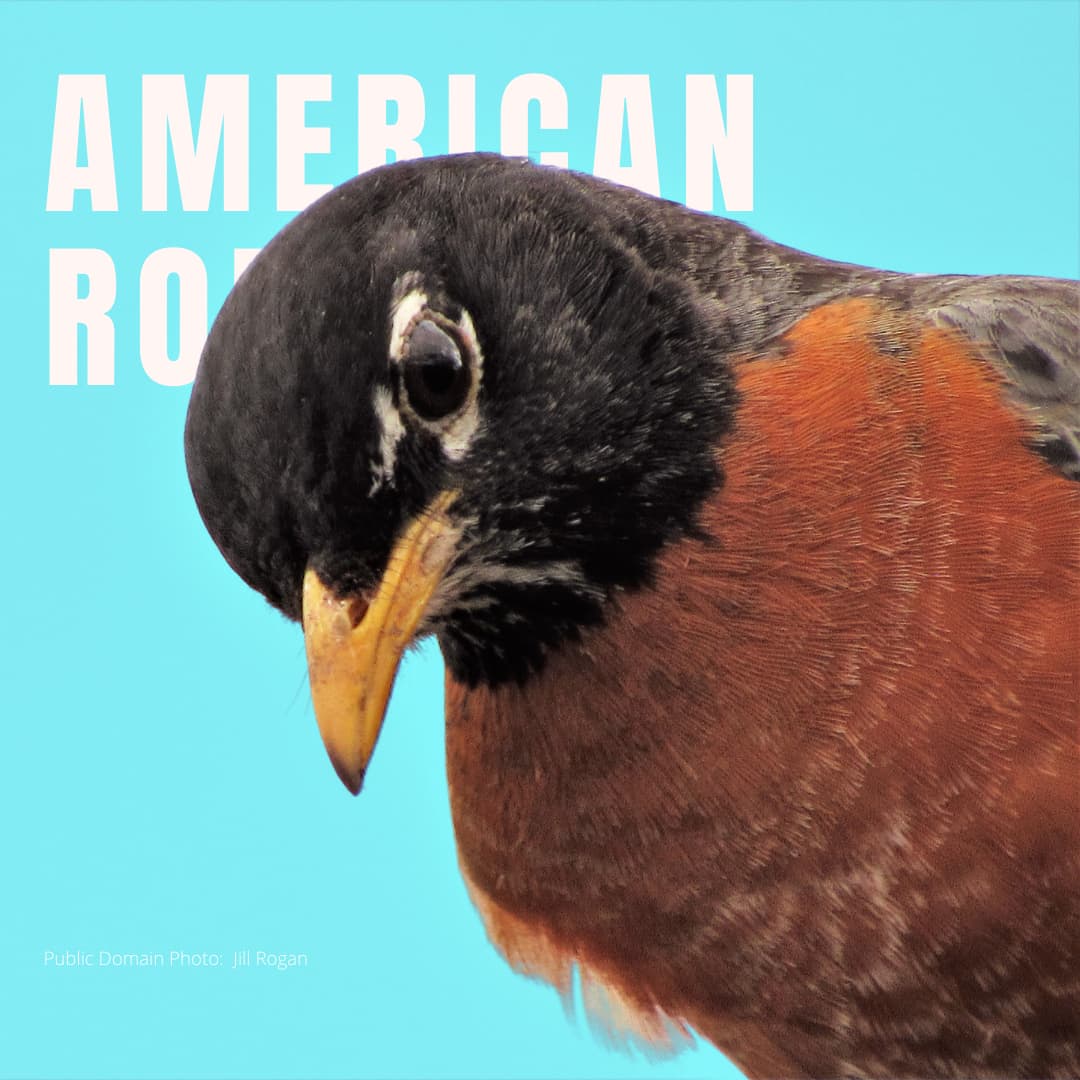
The American Robin is North America’s most abundant landbird, 370 million strong, yet it nearly vanished from entire university campuses in the 1950s. The bird that inspired Rachel Carson’s Silent Spring recovered from DDT poisoning only to face new threats: a 20-40% regional decline since 2000, a climate-driven food gap in the Rockies, and an unexpected role in America’s West Nile virus epidemic.
The Bird That Changed Environmental Law
In January 1958, a Massachusetts woman named Olga Owens Huckins wrote a letter to The Boston Herald describing what she’d witnessed on her property after aerial DDT spraying: birds lying dead on her lawn, their legs drawn up to their chests, their bills gaping. She sent a copy to her friend Rachel Carson. The letter did not ask Carson to write a book. It just described what happened.
What followed was four years of research, a 368-page manuscript, and a political firestorm that culminated in the 1972 ban of DDT in the United States — the founding act of American environmental law.
The bird at the center of that story was not a rare species on the edge of its range. It was the robin. Your robin. The one that shows up in early April like it owns the yard, pulls worms from the lawn with surgical confidence, and fills the 4 a.m. darkness with song before anything else stirs.
“Robin is one of the most native and democratic of our birds; he is one of the family, and seems much nearer to us than those rare, exotic visitants, as the orchard starling or rose-breasted grosbeak.” Quote ID: 1-022
John Burroughs wrote that in 1871. More than 150 years later, the robin remains exactly that — the family bird, the democratic bird, the bird you don’t have to go anywhere to see. Which made its near-disappearance all the more alarming. And all the more instructive.
Identification
What You’re Looking At
The American Robin is the largest thrush in North America — 8 to 11 inches long, 12 to 16-inch wingspan, weighing about 3 ounces — built like a bird that spends a lot of time running across lawns.1 The male is the familiar image: dark charcoal-gray head and back, brick-red chest, white belly patch visible in flight, broken white eye-ring, yellow-orange bill. Females carry the same field marks but washed out — browner above, paler on the breast — a distinction that becomes obvious once you’ve seen a mated pair on the same branch.
The 7 subspecies add regional texture. Western birds trend slightly paler; some subspecies show more white on the outer tail feathers. But the basic silhouette — robust thrush, upright posture, purposeful locomotion — doesn’t change.1
American Robin Quick ID Box
| Feature | Details |
|---|---|
| Size | 8–11 in; 12–16 in wingspan; ~3 oz |
| Adult Male | Black head, brick-red breast, gray back, yellow bill |
| Adult Female | Same pattern, browner/paler throughout |
| Juvenile | Spotted breast (thrush ancestry visible), streaked back |
| In Flight | White belly patch, white tail corners |
| Confusion Species | Varied Thrush — similar orange-brick breast but adds black breast band, orange supercilium, and barred wings; Pacific Northwest forests only |
The European Robin Myth: The bird colonists named “robin” out of homesickness for the European Robin (Erithacus rubecula) is actually no relation. The American Robin is a true thrush (family Turdidae); the European Robin belongs to Muscicapidae, the Old World flycatchers. They share an orange-red breast and little else — the American Robin is roughly twice the European’s size and occupies a completely different ecological niche. The name is an artifact of colonial nostalgia, not ornithology.
Voice
“…in a spirit of utter abandonment, he carols his simple strain. And sitting thus amid the stark, silent trees, above the wet, cold earth, with the chill of winter still in the air, there is no fitter or sweeter songster in the whole year round.” Quote ID: 1-021
Burroughs had the robin’s vocal character exactly right, and the robin hasn’t changed. The song is a rolling, liquid caroling — cheerily, cheer-up, cheerio — delivered in unhurried phrases with brief pauses between. It is not a complicated song. It doesn’t need to be. Volume and persistence are the strategy: the robin is typically among the first birds to begin singing before dawn and among the last to go quiet at dusk, often continuing after other species have gone silent.
The dawn chorus role is not accidental. Robins use low-light conditions that favor their large eyes, beginning to sing when light levels are too dim for most competing species. The effect, from inside a house with windows open in April, is that a single bird appears to own the entire neighborhood. It doesn’t. It just got there first.
Call note: a sharp, clucking tut-tut-tut given in alarm, escalating to a high, thin seee when a predator is spotted — the same call that sends every bird in earshot into the canopy.
Behavior and Nesting
“See the robin hop along upon the ground, strike an attitude, scratch for a worm, fix his eye upon something before him or upon the beholder, flip his wings suspiciously, fly straight to his perch, or sit at sundown on some high branch caroling his sweet and honest strain, and you have seen what is characteristic of all the thrushes.” Quote ID: 8-055
Burroughs describes the robin foraging, and what he describes — though he couldn’t have known this — is visual triangulation. When a robin tilts its head sideways on a lawn, it is not listening for earthworms moving underground. It is angling one eye toward the surface at a precise angle to detect micro-movement in the soil. A 1965 study by Heppner confirmed that sight is the primary worm-detection mechanism; hearing assists only when visibility is impaired. The head-tilt is not an ear pressed to the ground. It’s a targeting system.2
Foraging diet shifts by season. Summer: earthworms and insects make up the bulk of meals, with earthworms — entirely non-native in North America, having arrived from Europe with the colonists — now integral to the robin’s diet in ways that predate only a few centuries of contact. Winter: robins shift heavily to fruits and berries, gathering in nomadic flocks wherever food is locally abundant. This winter behavior explains a persistent misconception about robin migration: many people believe all robins leave in the fall and return in the spring. In reality, some populations winter in the same regions year-round, simply moving from lawns into woods and berry patches. They become invisible to the casual observer and then “return” when they move back to open lawn foraging in late winter.
The Fermented Berry Effect is one of the robin’s stranger documented behaviors. Robins flock to Pyracantha (firethorn) berries in late fall, consuming them in quantity after the berries have begun to ferment on the shrub. The result is visibly intoxicated birds — tilting, falling over while walking, and disoriented in flight. The behavior is well-documented and apparently harmless, resolving as the birds metabolize the alcohol.13
Nesting
The nest is one of the more distinctive in North American ornithology — a three-layer cup construction that no other common species replicates. The outer layer is coarse grass and twigs. The middle layer is a deliberate mud cup, formed by the female pressing mud against her breast in a rotating motion. The inner lining is fine, dry grass. The result is a rigid, weatherproof structure that can survive a full breeding season.<sup>1</sup>
Robins are aggressive, prolific nesters — up to three broods per year, with roughly 40% nest success accounting for predation and weather.1 Courtship, when it happens, is elaborate:
“He followed her to the ground, poured into her ear a fine, half-suppressed warble, offered her a worm, flew back to the tree again with a great spread of plumage, hopped around her on the branches, chirruped, chattered, flew gallantly at an intruder, and was back in an instant at her side.” Quote ID: 4-057
One hundred fifty years after Burroughs watched that display, the choreography is unchanged.
Conservation
Historical Baseline: The Democratic Bird
“Not long after the bluebird comes the robin, sometimes in March, but in most of the Northern States, April is the month of the robin.” Quote ID: 1-019
When Burroughs wrote that in 1871, the American Robin was a given — abundant in every settled landscape, breeding from Alaska to the Mexican highlands, wintering across the southern tier. The robin was, as he noted, democratic: it required no special habitat, no particular forest type, no undisturbed acreage. A lawn, a tree, and some earthworms were sufficient. It followed European settlement across the continent, exploiting the open lawns and disturbed edges that agriculture created.
In 1871, no one worried about robins. There were simply robins everywhere, the way there had always been robins. The Breeding Bird Survey would not exist for another 95 years. The concept of monitoring common species had not yet been invented, because common species did not yet need monitoring.
That assumption would not survive the 1950s intact.
The Decline: Eleven Worms
The Dutch Elm Disease epidemic arrived in North America in the 1930s and spread through American cities with a quiet, devastating efficiency. By the 1950s, municipalities across the Midwest and Northeast were losing their elm canopy — the arching trees that had defined American streetscapes for a century — and responding with the only weapon available: aerial DDT spraying, applied to every elm tree in sight.
At Michigan State University in East Lansing, ornithologist George Wallace began to notice something wrong in the spring of 1954. Robins were dying on campus. Not a few — many. By 1958, the pattern was undeniable: the spring DDT applications designed to protect the elms were killing the robins. By 1959, robins had been completely extirpated from the 5,200-acre MSU campus. Wallace, working with colleague J.F. Mehner, traced the mechanism: DDT applied to elm leaves washed to the ground, was absorbed by earthworms, and concentrated in their tissues. When robins ate those worms, they were eating accumulated poison. As few as 11 earthworms delivered a lethal dose of DDT to a robin.5
Wallace’s 1959 publication in The Atlantic Naturalist documented the worm-robin-DDT pathway in precise terms. He had identified what would later be called Bioaccumulated Catastrophe — the mechanism by which a chemical applied to leaves at sub-lethal concentrations became lethal by the time it moved three steps up the food chain.
Olga Huckins’s 1958 letter reached Rachel Carson around the same time Wallace was documenting the MSU deaths. Carson, already a distinguished marine biologist and nature writer, recognized that these were not isolated incidents. They were data points in a pattern. She spent the next four years gathering more.
A 1963 DDT spray program in Hanover, New Hampshire, demonstrated the scale of what was happening: 70% of the resident robin population — 350 to 400 individuals — was lost in a single spring.5 The same spray events killing robins were also killing eagles, ospreys, and peregrine falcons — predators that accumulated even higher DDT concentrations through their own food chains. The bald eagle, the national bird, was in freefall.
Silent Spring was published in September 1962. The chemical industry’s response was immediate and vicious: Carson was called hysterical, emotional, and a communist sympathizer. The attacks were personal in ways that would be recognizable today. They did not succeed. The science held.
The Recovery: The Bureaucrat With Courage
The Environmental Defense Fund was formed in 1967, specifically as a legal response to DDT. Its founding attorneys began filing lawsuits in New York, Michigan, Wisconsin, and Washington, D.C., pushing for a federal ban.7 The newly created EPA, established in 1970, became the arena. William Ruckelshaus, the agency’s first administrator, presided over seven months of contested hearings in 1972.8
The testimony ran to thousands of pages. The chemical industry argued DDT was essential to agriculture and human health. The scientific community argued that the accumulating evidence of ecological damage was unambiguous. Ruckelshaus had to decide.
On June 14, 1972, he banned DDT.
The recovery was not immediate, but it was measurable. Bald eagle populations climbed from fewer than 500 breeding pairs in the mid-1960s to more than 10,000 pairs today.7 Peregrine falcons returned to eastern cities. Ospreys rebuilt their Atlantic coast populations. And robins, never extirpated across their full range as the eagles nearly were, rebounded to a current continental population estimated at 370 million individuals — the most abundant landbird in North America, ahead of red-winged blackbirds, European starlings, and mourning doves.3
Accidental Abundance describes what happened: the DDT ban did not create a robin management program. It simply removed a poison. The robins did the rest themselves.
Current Status: New Threats in an Old Landscape
The recovery from DDT does not mean the robin is safe. Two threats have emerged since 2000 that complicate the picture considerably.
The first is West Nile Viral Amplification — a phrase that sounds technical until you understand what it means. Culex pipiens mosquitoes, the primary vector of West Nile virus (WNV) in North America, feed preferentially on American Robins during May and June. Robins are highly susceptible to the virus, and mosquitoes that feed on infected robins become infectious. By late July, as robins disperse from breeding territories, mosquito feeding shifts toward humans, and the human WNV epidemic peaks in August and September. Kilpatrick et al. (2006) found that robins accounted for between 25% and 71% of Culex blood meals across six states, despite making up a small fraction of available bird biomass.9 The robin’s abundance and its mosquito attractiveness make it the engine of America’s annual WNV cycle. It is both victim and vector — not by design, but by ecological coincidence.
The second is Phenological Displacement in the Rocky Mountain West. Robins have shifted their spring arrival dates roughly 14 days earlier since 1981, tracking warming temperatures.11 The problem is that snow-free ground — the condition that allows earthworm foraging — has not advanced at the same rate. The gap between robin arrival and accessible food has grown by 18 days. Birds arrive on schedule, find frozen ground, and face starvation during the window when they most need to establish territories and begin nesting.
These two threats don’t show up in the continental population estimate. They show up in regional surveys: 20 to 40% population declines since 2000 in some neighboring states and provinces, with no clear single explanation identified.10 The most abundant landbird in North America is declining in measurable ways in places where, a generation ago, decline would have seemed impossible.
The Breeding Bird Survey trend line from 1966 to 2022 shows the continental picture as approximately stable, with a modest +0.13% annual increase over the full period.3,4 But stability at the continental scale can mask serious regional deterioration. The robin’s own history teaches this lesson. Campus populations were extirpated in the 1950s, while continental abundance statistics were never compiled. Nobody was counting carefully enough until George Wallace started counting.
Frequently Asked Questions
Why do robins pull worms out of the ground — how do they find them?
Primarily by sight, not sound. The head-tilt that looks like listening is actually visual triangulation — the robin is angling one eye toward the surface to detect micro-movement in the soil. A 1965 experiment by Heppner confirmed that sight is the dominant detection mechanism; hearing assists only in low-visibility conditions. The worm, once located, is extracted by beak grip and patient tugging — earthworms can be pulled to lengths of several inches before releasing their grip on the soil.2
Are robins really a sign of spring, or do some stay all winter?
Both things are true. Many robin populations migrate south in fall and return in spring, and their reappearance on suburban lawns is a reliable seasonal signal. But a substantial portion of the population winters in the same geographic areas year-round, simply shifting from open lawn foraging to woodland berry patches. These birds are effectively invisible to casual observers until they return to lawns in late winter. What looks like “the return of the robins” is often those birds moving back into view, not arriving from the south.1
What’s the difference between a male and female robin?
The male has a dark black head and a deep brick-red breast. The female shows the same pattern but browner — grayer head, paler breast. The distinction is visible but subtle; the two birds are often confused at a distance. In a mated pair seen together, the male is noticeably darker.1
What does a juvenile robin look like, and why are they spotted?
Juvenile robins have spotted breasts — a pattern that makes them look like a completely different species until the spots fade. This is phylogenetic honesty: the American Robin is a thrush, and spotted juvenile plumage is the ancestral thrush condition. The spots serve as camouflage during the vulnerable post-fledging period. Adults lose the spots in their first fall.1
Why do robins run a few steps, stop, and tilt their head? Are they listening for worms?
They are not listening. See the first FAQ above. The run-stop-tilt sequence is a foraging technique: running moves the bird across the ground efficiently, stopping allows careful visual scanning, and the head-tilt positions the eye for maximum surface-movement detection. The sequence is so consistent that it reads as behavioral punctuation — a recognizable micro-routine that Burroughs described in 1871 and that hasn’t changed.2
How can I attract robins to my backyard?
Robins do not use seed feeders. They forage on the ground for earthworms and insects and in shrubs and trees for fruit. To attract them: maintain areas of open lawn (their primary foraging habitat), plant native fruiting shrubs like serviceberry, holly, or dogwood, and provide a birdbath with moving water — robins are enthusiastic bathers and respond strongly to the sound of dripping water. Avoid pesticide applications on lawns; robins absorbing earthworms from treated ground remain vulnerable to pesticide accumulation on a smaller scale than the DDT era, but through the same mechanism.1
Do robins use nest boxes?
No. Robins are open-cup nesters and will not enter enclosed nest boxes. They will, however, use open-fronted nest platforms mounted on buildings or trees — a flat surface with a partial back and roof provides the structural support the female needs to anchor her mud-cup nest. These are widely available, and robins have been documented using them readily.1
Why are robin populations declining in some parts of the country?
Regional declines of 20-40% since 2000 have been documented in portions of the Northeast and Upper Midwest, though the continent-wide population remains stable.10 Multiple factors are likely implicated: West Nile virus mortality, climate-driven phenological mismatch in the Rockies, habitat changes, and pesticide pressure. The absence of a single clear explanation suggests multiple interacting stressors rather than one identifiable cause, which makes the problem harder to address than the DDT crisis was, once the mechanism was understood.
Key Takeaways
- The American Robin is the most abundant landbird in North America, with a population of 370 million individuals — yet it was extirpated from entire university campuses in the 1950s by DDT-contaminated earthworms.3
- As few as 11 earthworms carried enough accumulated DDT to kill a single robin — the mechanism that Rachel Carson documented in Silent Spring and that led to the 1972 DDT ban.5
- Robin populations have declined 20-40% regionally since 2000 despite apparent continental stability, driven by West Nile virus, climate phenology mismatch, and ongoing pesticide pressure.10
- American Robins are responsible for up to 71% of Culex pipiens blood meals in some regions, making them the primary amplifier of West Nile virus before mosquitoes shift to human hosts in late summer.9
- In the Rocky Mountain West, an 18-day gap has opened between robin spring arrival and first accessible ground — birds arriving on warming-driven early schedules to find frozen soil and no food.11
- Action item for you: Eliminate lawn pesticide applications. The robin’s DDT history is a demonstration of what pesticide accumulation does at scale; the same mechanism operates with modern insecticides and the same bird.
Bibliography
Modern Scientific Sources
[1] Cornell Lab of Ornithology. American Robin Life History, Identification, and Overview. All About Birds. https://www.allaboutbirds.org/guide/American_Robin/lifehistory
[2] Cornell Lab of Ornithology. American Robin Identification. All About Birds. https://www.allaboutbirds.org/guide/American_Robin/id
[3] Cornell Lab of Ornithology. American Robin Overview. All About Birds. https://www.allaboutbirds.org/guide/American_Robin/overview
[4] U.S. Geological Survey. North American Breeding Bird Survey Analysis Results 1966–2022. USGS. https://www.usgs.gov/data/north-american-breeding-bird-survey-analysis-results-1966-2022
[5] U.S. Geological Survey. Bird Mortality Following DDT Spray. USGS Publications Warehouse. https://pubs.usgs.gov/publication/5221295
[6] Stoll, Mark. “A World Drenched in Pesticides: Rachel Carson and Silent Spring.” Origins: Current Events in Historical Perspective, Ohio State University. https://origins.osu.edu/read/world-drenched-pesticides-rachel-carson-silent-spring
[7] Scientific American. “Rachel Carson, Silent Spring, and the 1972 DDT Ban — How Birds Thrived.” Scientific American. https://www.scientificamerican.com/article/rachel-carson-silent-spring-1972-ddt-ban-birds-thrive/
[8] Virginia Tech Undergraduate Historical Review. “The DDT Ban and the Rise of American Environmentalism.” VTUHR 1. https://vtuhr.org/articles/10.21061/vtuhr.v1i0.5
[9] Kilpatrick, A.M., Daszak, P., Jones, M.J., Marra, P.P., Kramer, L.D. (2006). “Host heterogeneity dominates West Nile virus transmission.” PLoS Biology 4(3). https://pubmed.ncbi.nlm.nih.gov/16494532/
[10] New Hampshire Audubon. American Robin: State of the Birds Database. NH Audubon. https://stateofthebirds.nhaududon.org/bird_database/american-robin/
[11] Inouye, D.W., Barr, B., Armitage, K.B., Inouye, B.D. (2000). “Climate change is affecting altitudinal migrants and hibernating species.” Proceedings of the National Academy of Sciences 97(4): 1630–1633. https://www.pnas.org/content/97/4/1630
[12] Audubon Society. American Robin Field Guide. National Audubon Society. https://www.audubon.org/field-guide/bird/american-robin
[13] Opar, Alisa. “Spring Is in the Air—and So Are Intoxicated Birds.” National Audubon Society, March 2, 2011. https://www.audubon.org/news/spring-air-and-so-are-intoxicated-birds
Historical Sources
Return of the Birds: A John Burroughs Wake-Robin Revival (2022) 44from26. (Peter Meddick, editor, 2022), audiobook on Audible.
Quote 1-019: April arrival timing. Source
Quote 1-021: Dawn carol in winter trees. Source
Quote 1-022: The democratic bird. Source
Quote 4-057: Courtship display. Source
Quote 8-055: Foraging and the thrush character. Source
Carson, Rachel. Silent Spring. Boston: Houghton Mifflin, 1962.
Mehner, J.F. and Wallace, G.J. (1959). “Robin populations and insecticides.” Atlantic Naturalist 14: 4–9.